|
|
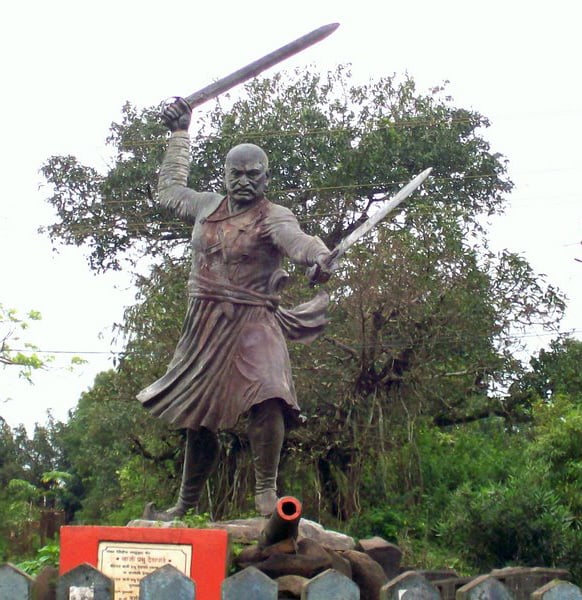 Bajiprabhu Deshpande
Index
- Introduction
- Battle of Pawankhind
- A Torrid chase
- The towering stand of the mighty Warrior
- Escape Complete
- Honour : Baji becomes a Martyr
Bajiprabhu Deshpande: True Devotee of Chhatrapati Shivaji Maharaj
For any true Hindu and lover of Bharatvarsha, the study of Chhatrapati Shivaji Maharaj’s life is deeply awe-inspiring. Beyond being a great and ferocious warrior who pioneered tactics to counter foreign aggression in 17th-century Bharat, Shivaji Maharaj was a devoted son to his mother Jijau, a devout seeker of Goddess Bhavani, and a champion protector of the weak and innocent. His daring exploits as a proud Maratha warrior king remain extraordinary.
Throughout these endeavors, Shivaji Maharaj relied on the valiant support and supreme sacrifices of his courageous men, who placed their leader’s dream of establishing ‘Hindavi Swarajya’ (Hindu self-rule) above everything else, including their possessions, families, and lives. Chief among these extraordinary heroes was the great Bajiprabhu Deshpande, a brave heart who selflessly sacrificed his life to save his king and protect the vision of Swarajya.
Introduction
Bajiprabhu Deshpande was born into the Chandrasainya Kayastha Prabhu (CKP) community, traditionally known for administrative roles. From an early age, however, Bajiprabhu displayed a strong martial spirit. During a period when regional Sultanates dominated the Deccan, he sought to serve his land and resist foreign hegemony. The rise of Chhatrapati Shivaji Maharaj provided him with the ideal leader and cause.
Recognizing Bajiprabhu’s military talent and devotion to the vision of Hindavi Swarajya, Shivaji Maharaj appointed him as a key military commander in the southern Maharashtra region around Kolhapur. Bajiprabhu played a vital operational role during the conflict with Afzal Khan, bringing with him a disciplined band of Maratha warriors from the Bandal regiment, including Visaji Murambak, who was as tall and heavily built as Afzal Khan. Shivaji Maharaj practiced the duel with Afzal Khan using Visaji as his sparring partner.
The battle of Pawankhind
 |
Following the slaying of Afzal Khan, Shivaji Maharaj and his men created havoc (naak-mein-dum) among the powerful forces of the Adilshahi Sultanate, relentlessly harrying them with ferocious guerrilla tactics. Supported by good intelligence, the Marathas brought relief to innocent Hindu subjects suffering under the tyranny of the Sultanate’s army.
During this period, Shivaji Maharaj based himself at Panhala Fort. Learning of his presence, the Adilshahi army immediately laid siege to the fort under the command of General Siddi Jauhar. The siege dragged on for months, cutting off vital supplies and forcing Shivaji Maharaj to find an escape route.
All external attempts to break the blockade—including efforts by Maratha Senapati Netaji Palkar—were repulsed. Rather than launching a suicidal frontal attack against 10,000 enemy troops, Shivaji Maharaj devised a strategic escape to Vishalgad Fort, located about 60 kilometers away.
First, Shivaji Maharaj sent his envoy (vakil) to Siddi Jauhar, feigning readiness to negotiate terms of surrender. Relieved after months of arduous siege work, the enemy relaxed their guard.
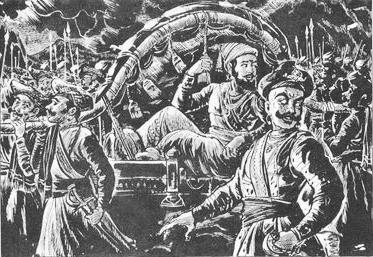
On a stormy, rainy night (Guru Purnima / Ashadh Vadya), a band of 600 select Maratha warriors set out under the leadership of Chhatrapati Shivaji Maharaj and Bajiprabhu Deshpande. They split into two groups. The first was a decoy team led by a brave barber named Shiva Kashid (Shiva Nhavi), who bore a striking physical resemblance to Shivaji Maharaj and took a prominent route to draw enemy attention. Meanwhile, the main force comprising Shivaji Maharaj, Bajiprabhu Deshpande, and the core band of Maratha warriors, pressed ahead along a treacherous mountain path toward Vishalgad.
Shiva Kashid’s group served as the perfect bait as Siddi Johar’s alert troops who had gotten wind of the escape plan through their network of informers. Alerted by informers, enemy troops captured Shiva Kashid’s decoy party. The captors celebrated, believing they had caught Shivaji Maharaj, but grew enraged upon realizing the subterfuge. They promptly beheaded Shiva Kashid. Shiva Kashid’s heroic self-sacrifice bought precious time for the real Shivaji to escape into the night.
A torrid chase
Realizing they had been tricked, an Adilshahi force of over 4,000 soldiers launched a rapid pursuit. Chhatrapati Shivaji Maharaj and his men set an electrifying pace through the rainy night, pushing their steeds to absolute exhaustion.
As the horses reached their physical limit, sweat lathering their backs, the Maratha team arrived at Ghodkhind (later renamed Pawankhind), a narrow mountain pass that allowed only a few soldiers to pass through at a time.
The Towering stand of the mighty Warrior
 |
At Ghodkhind, the immortal legend began. Bajiprabhu Deshpande volunteered to hold the pass with a select group of 300 Marathas so Shivaji Maharaj could press on towards Vishalgad. Reluctantly, Shivaji Maharaj agreed and set off with the remaining 300 men. It was agreed that three cannon shots would be fired from Vishalgad as a signal that Shivaji Maharaj had arrived safely.
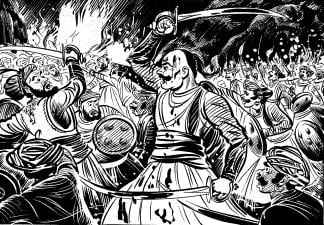
At Ghodkhind, the 300 Maratha warriors fought like caged tigers to their war cry: HAR HAR MAHADEV!
Baji and his men were outnumbered by nearly a 1:10 ratio. The Jihadis, in turn, were relentless as they attacked the narrow pass in wave after frenzied wave. The pursuing enemy attacked in wave after frenzied wave, but Bajiprabhu stood in the vanguard like a granite wall. Wielding two heavy swords (dandpatta), one in each hand, he single-handedly repulsed entire charges. Bajiprabhu sustained severe wounds—sword cuts and spear thrusts crisscrossing his body. Though on the verge of collapsing from blood loss, his iron will held firm. He refused to yield until he heard the cannon shots from Vishalgad.
Escape complete
While Bajiprabhu held the pass, Chhatrapati Shivaji Maharaj reached the base of Vishalgad Fort. However, the fort was already encircled by another enemy force under sardar Suryarao Surve. Shivaji Maharaj and his 300 men attacked the besieging base with such fury that they shattered the enemy lines and forced their way up to the fort.
After what felt like an eternity at Pawankhind, three cannon shots boomed from distant Vishalgad.
It was near dawn. Bajiprabhu, mortally wounded, heard the signal and smiled, knowing that Chhatrapati Shivaji Maharaj and Hindavi Swarajya were safe. With a final cry of ‘HAR HAR MAHADEV’, the surviving Marathas cleared the pass, carrying their fallen commander with them. Bajiprabhu Deshpande passed away shortly after, earning an immortal place in Indian history. Bajiprabhu’s iron will ensured that Chhatrapati Shivaji Maharaj and the Hindavi Swarajya had survived against heavy odds.
Honour : Baji becomes a Martyr
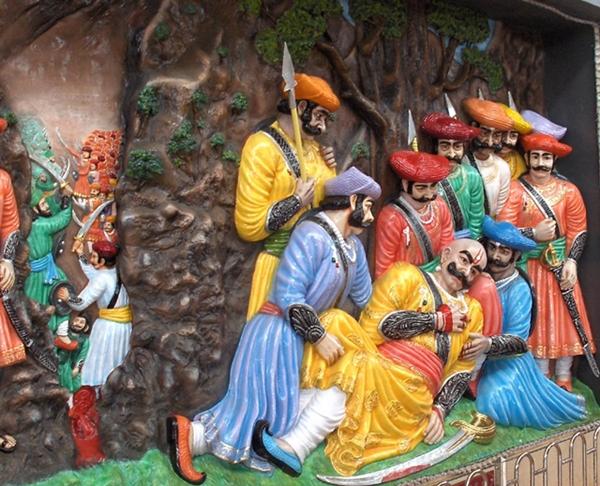 |
Shivaji Maharaj was deeply grieved by the loss of Bajiprabhu Deshpande, Shiva Kashid, and the fallen warriors.
In Baji’s honour, he renamed the Ghodkind as Pawankhind (Pawan meaning pure – purified by the blood of this brave martyr). For the rest of his life, Shivaji Maharaj would also act as the guardian for Baji’s children.
A sword of honor was presented to the Bandal infantry. Shivaji Maharaj personally visited Bajiprabhu’s home in Kasabe Sindh (near Bhor, Pune district) to pay tribute. Bajiprabhu’s eldest son was given command of a military division, his other seven sons were granted the Honour of the Palanquin (Palkhi), and the family was granted Manache Paan (“Honour of the Court”).
Dhanaji Jadhav, son of slain Maratha commander Sambhusing Jadhav who died fighting beside Baji Prabhu, was inducted into the army (and later grew up to become a famed Commander-in-Chief of the Maratha Empire).
The sacrifice of Bajiprabhu and his men remains legendary. To this day, thousands of youths in Maharashtra trek the 70 km route between Panhala and Vishalgad, while folk songs (powadas) continue to recite the story of Pawankhind across Bharat.