Birsa Munda (1875–1900) was a legendary tribal leader and a folk hero, belonging to the Munda tribe who was behind the Millenarian movement that rose in the tribal belt of modern day Bihar, and Jharkhand during the British Raj. This uprising shook the tribal belt of modern-day Bihar and Jharkhand. Ultimately, his fierce leadership made him a vital figure in the Indian independence movement.
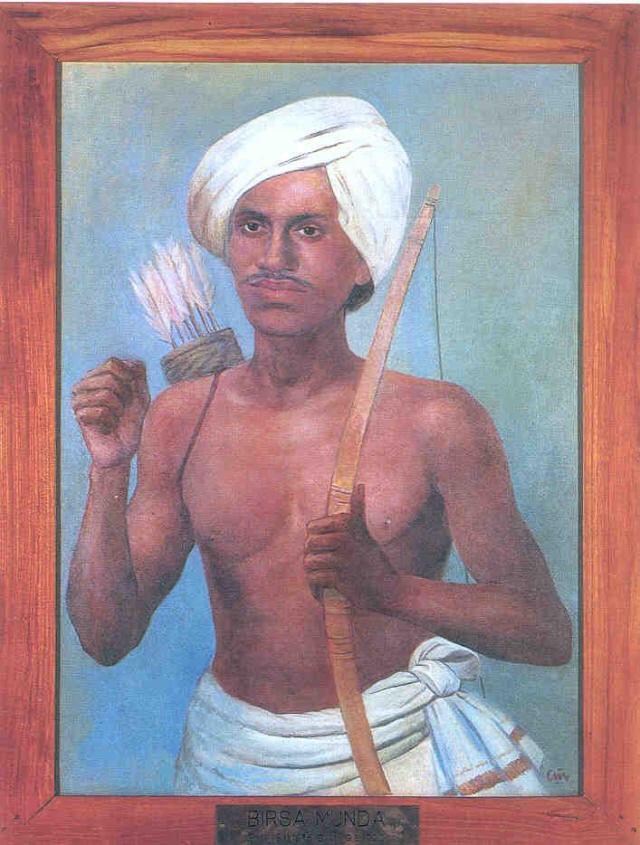
Birsa Munda is remembered with immense respect as a towering freedom fighter in the Indian struggle for independence against British colonialism. His achievements in the freedom struggle all are the more remarkable considering he accomplished them before his 25th year.
Birsa’s devotion to his people was so profound that he was almost revered as God by his followers. By the time he was in his early 20s, his activities in the tribal areas of present day Jharkhand (formerly part of Bihar) had already begun to deeply alarm the British establishment nt. He was eventually caught by the British forces on 3 February 1900, at just 25 years old. Shortly thereafter, on June 9, 1900, he died under mysterious circumstances while imprisoned in Ranchi Jail.
Early childhood
Birsa Munda was born in 1875 on a Thursday, and according to the Munda custom prevalent at the time, he was named after the day of his birth. Folk songs reflect some confusion and refer to both Ulihatu and Chalkad as his birthplace. Ulihatu was the birthplace of Sugana Munda, Birsa’s father. The claim that Ulihatu was Birsa’s birthplace is based on the fact that his elder brother, Komta Munda, lived in the village and that his ancestral house still exists there, albeit in a dilapidated condition.
Birsa’s father, his mother Karmi Hatu,[1] and his younger brother, Pasna Munda, left Ulihatu and proceeded to Kurumbda near Birbanki in search of employment as labourers or crop-sharers (sajhadar) or ryots. While living in Kurumbda Birsa’s elder brother, Komta, and his sister, Daskir, were born . The family later relocated to Bamba, where Birsa’s elder sister, Champa, was born, followed by Birsa himself.
Shortly after Birsa’s birth, his family left Bamba. A dispute between the Mundas and their ryots in which his father was involved as a witness, was the immediate reason for proceeding to Chalkad, Sugana’s mother’s village, where they were granted refuge by Bir Singh , the Munda (head-man) of the village. Consequently, Birsa’s birth ceremony was performed at Chalkad.
After childhood
Birsa Munda’s early years were spent with his parents in Chalkad, where his upbringing closely mirrored that of any average Munda child. Munda folklore fondly describes him as a strong, handsome boy playing in the sand and dust with his friends. He routinely grazed sheep in the forest of Bohonda. When he grew up, he shared an interest in playing the flute, in which he became adept, so movingly that, according to lore, all living beings would gather to listen. He went round with the tuila, the one-stringed instrument made from the pumpkin, in his hand and kept the flute strung to his waist spending his most exciting moments of his childhood at the akhara (the village dancing ground). Yet, even then, a close contemporary noted that Birsa frequently spoke of strange, profound ideas.
Driven by severe poverty, Birsa was sent to Ayubhatu, his maternal uncle’s village. Meanwhile, Komta Munda, his eldest brother, who was ten years of age, went to Kundi Bartoli, to work for a local Munda Kumta married,lived there for eight years, and then joined his father and younger brother at Chalkad.
Birsa lived in Ayubhatu for two years, attending a school in Salga run by Jaipal Nag. He later accompanied his maternal aunt, Joni, who was fond of him, to her new home in Khatanga after her marriage. There, he encountered a pracharak, who visited a few local families in the village, who had been converted to Christianity and openly criticised the traditional Munda customs.
Later, while working as a herdsman, Birsa became so preoccupied with his thoughts and studies that he lost track of his herd, allowing the sheep and goats to graze on standing crops. The field’s owner beat him and deemed him unfit for the job.. Leaving the village, Birsa stayed briefly with his brother in Kundi Bartoli before moving to the German Mission at Burju, where he cleared his lower primary examination. He then attended the Gossner Evangelical Lutheran Mission School in Chaibasa. It was here that his transformation into a revolutionary tribal leader truly began.. When a missionary Father lectured the children on the “Kingdom of Heaven,” the young Birsa, baptised as Daud Purty, boldly challenged him, asking where this Kingdom of Heaven was while zamindars (landlords) and colonial authorities ruthlessly exploited the tribal people in their own homeland.
The Formative Period (1886-1894)
Birsa’s long stay at Chaibasa from 1886 to 1890 constituted a formative period of his life. The influence of Christianity shaped his own religion. This period was marked by the German and Roman Catholic Christian agitation. Because Chaibasa was close to the centre of the anti-colonial Sardar Larai (the Sardars’ agitation), Sugana Munda decided to withdraw his son from the mission school. Being caught up in this turmoil left an indelible mark on young Birsa’s mind, shaping it with an anti-missionary and anti-government character. Soon after leaving Chaibasa in 1890 Birsa and his family gave up their membership of the German mission aligning themselves fully with the Sardar movement. He later left Corbera in the wake of the escalating Sardar agitation. He participated in the agitation stemming from popular anger over e British restrictions imposed on the traditional rights of the Mundas within the protected forest, under the leadership of Gidiun of Piring in the Porhat area. Between 1893 and 1894, under the Indian Forest Act VII of 1882, the British government claimed ownership of all village waste lands and classified them as protected forests. As forest settlement operations launched across Singhbhum, Palamau, and Manbhum, measures were taken to determine the rights of the forest dwelling communities. Forest villages were marked off into calculated blocks, restricting the tribals’ access to the very cultivable and waste lands they relied on for survival.
In 1894, Birsa had grown up into a strong, shrewd, intelligent and handsome young man. Standing 5 feet 4 inches tall—which was quite tall for a Munda at the time—he possessed remarkable physical strength, once single-handedly repairing the rain-damaged Dombari tank at Gorbera. His real appearance was extraordinarily pleasant : his features were regular, his eyes bright and full of intelligence and his complexion noticeably lighter than most of his people.
During the period he had a spell of experience, typical of a young man of his age and charm. While on a sojourn in the neighbourhood of village Sankara in Singhbhum, he found a suitable companion, presented her parents with jewels and proposed marriage. However, later, on his return from jail he did not find her faithful to him and parted ways with her . Another woman who served him at Chalkad was the sister of Mathias Munda. On his release from prison, the daughter of Mathura Muda of Koensar who was kept by Kali Munda, and the wife of Jaga Munda of Jiuri insisted on becoming wives of Birsa. He refused them, strictly instructing Jaga Munda’s wife to return to her husband. Another rather well-known woman who stayed with Birsa was Sali of Burudih.
Birsa stressed monogamy at a later stage in his life. Rising from the lowest ranks of the peasantry, Birsa lived as a ryot (tenant farmer). Unlike ryots elsewhere, those within the tribal Mundari Khuntkatti system possessed almost no rights, as all local privileges were monopolized by the founding lineages, reducing ordinary peasants to mere crop-sharers. Birsa’s own experience as a young boy, spent moving from place to place in search of employment, gave him an insight into the agrarian crisis and forest exploitation. He was no passive spectator but an active participant in the movement going on in the neighbourhood.
The Making of a Prophet
Birsa’s claim to be a messenger of God and the founder of a new religion, sounded preposterous to the Christian mission.. His new sect rapidly attracted followers, including many tribal converts who reverted from Christianity, most notably the Sardars. His simple system of offering was a direct challenge to the church which levied a tax. His concept of a single God appealed to his people, who found his faith to be an economical religion that saved them from the expenses of animal sacrifices. Birsa laid down a strict code of conduct: theft, lying, and murder were treated as anathema, and begging was prohibited.
The stories of Birsa as a healer, a miracle-worker, and a preacher spreadout of all proportion beyong the facts. The Mundas, Oraons, and Kharias flocked to Chalkad to see the new prophet and to be cured of their ailments. Both the Oraon and Munda communities extending up to Barwari and Chechari in Palamau became devoted ‘Birsaities’. Contemporary and later folk songs commemorate the tremendous impact of Birsa on his people, capturing their joy and expectations upon his advent. The name of ‘Dharti Aba’ was on everybody’s lips. Folk songs in Sadani showed that the first impact cut across the social divides as Hindus and Muslims also flocked to the new Sun of religion. All roads led to Chalkad
Birsa Munda and his movement
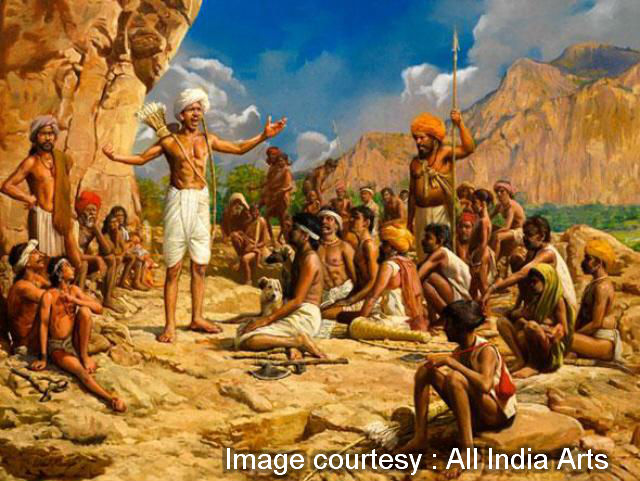
The British colonial system intensified the transformation of the tribal agrarian system into a feudal state. As the tribals with their primitive technology, could not generate a surplus, non-tribal peasantry were invited by the chiefs in Chhotanagpur, to settle on and cultivate the land. This led to the alienation of the lands held by the tribals. The new class of Thikadars were of more rapacious in nature and eager to make the most of its possessions.
In 1856 the number of the Jagirdars stood at about 600, and they held anywhere from one village to 150 villages. By 1874, the authority of the old Munda or Oraon chiefs had been almost entirely replaced by that of the farmers, introduced by the superior landlords. In some villages the aborigines had completely lost their proprietary rights, and had been reduced to the position of farm labourers.
Faced with twin challenges of agrarian breakdown and culture change, Birsa along with the Mundas responded through a series of revolts and uprisings under his leadership. The movement sought to assert rights of the Mundas as the real proprietors of the soil, and demanded the expulsion of middlemen and the British. He was treacherously caught on 3 February 1900 and died in mysterious conditions on 9 June 1900 in Ranchi Jail. Though he lived for a very short span of 25 years, he awakended the mind-set of the tribals and mobilised them in a small town of Chhotanagpur and became a source of fear to the British rulers.
Birsa Munda in popular culture
His birth anniversary which falls on 15 November, is still celebrated by tribal communities as far as Mysore and Kodagu districts in Karnataka. Official functions also takes place at his Samadhi Sthal, at Kokar Ranchi, the capital of Jharkhand.Today, there are a number of organisations, institutions and structures named after him, notably Birsa Munda Airport Ranchi, Birsa Institute of Technology Sindri, Birsa Munda Vanvasi Chattravas, Kanpur and Birsa Agricultural University.
The war cry of Bihar Regiment is Birsa Munda Ki Jai (Victory to Birsa Munda). In 2008, Hindi film based on the life of Birsa, Gandhi Se Pehle Gandhi was directed by Iqbal Durran based on his own novel by the same name. Another Hindi film, “Ulgulan-Ek Kranti (The Revolution)” was made in 2004 by Ashok Saran, in which 500 Birsaits or followers of Birsa acted.
Ramon Magsaysay Award winner, writer-activist Mahasweta Devi’s historical fiction, “Aranyer Adhikar” (Right to the Forest, 1977), a novel for which she won the Sahitya Akademi Award for Bengali in 1979, is based on his life and the Munda Rebellion against the British Raj in the late 19th century; she later wrote an abridged version Birsa Munda, specifically for young readers.