Share |

What is the method of performing Tarpan and Pitru tarpan?

Rating : Average Rating : 5.33 From 3 Voter(s)
Views : 6298
Average Rating : 5.33 From 3 Voter(s)
Views : 6298
-->

Contents -


1. Terminology of Shraddha

A. Pitar: When a human being dies, its subtle body gets freed from the dead body after performing the ritual of Shraddha and it gets position in the subtle plane meant for souls of dead persons. At that moment it assumes the designation of Pitar.

B. Parvan: After performing Sapindikaran Shraddha (Shraddha performed one day prior to one-year completion after the death of the person is called Sapindikaran Shraddha), the soul that has assumed the designation of Pitar now joins other Pitars and then gets further categorised as Parvan. Also, it gains authority so as to allow its descendants to perform Parvan Shraddha for it.

(Detailed information on Pitar and Parvan is under point 3 B in volume 2)

C. Pitrutrayi (Trio in Pitars): Generally son of the dead person has authority to perform Shraddha for the dead person. In his absence, other options are explored. The terminology of Shraddha has been prepared assuming the son as being the person who performs the shraddha. Therefore the soul of dead person for whom the Shraddha is being performed, is invoked as ‘father’ (father of the son performing Shraddha). One generation before, i.e. the father of dead person is referenced as ‘Pitamaha’ (grandfather of the son performing Shraddha). The grandfather of the dead person is referred to as ‘Prapitamaha’ (great grandfather of the son performing Shraddha). The earlier generations than these are not counted in trios of Pitars (Pitrutrayi), because it is assumed that they are liberated.

D. JivatpitrukWhen there is a male person whose father is alive, then such a person does not have authority to perform Shraddha. But he has right to perform Shraddha for his mother and grandfather (mother’s father). Also, generally, he even does not have the right to perform rituals of Narayannagbali,Ttripindi etc; however if these rituals are performed with the objective of conceiving a child, then the jivatpitruk can do so. In order to perform ‘Apasavya’, a jivatpitruk can only hold the thread in the thumb of the left hand and cannot hold it completely in his left hand.

E. Three ways of wearing the thread (janve) are Savya, Apasavya and Nivit: The thread should always be worn on the left shoulder. This style of wearing the thread is known as ‘savya’. When it is worn on the right shoulder it is known as ‘Apasavya’. When worn as a necklace, it is known as ‘Nivit’.

F. Offering ‘kshan’: During the ritual of shraddha, the deity and the deceased ancestors’ soul are invited by offering grass twigs (darbha) to them. This is called the offering ‘kshan’.

G. Pishangi: Rangoli drawn using ash and with chanting of mantras, around the meal plate arranged for the priest (Brahmin) is called as pishangi. (Offering food to priest (Brahmin) is considered as an important part of Shraddha. Rangoli is drawn in a clockwise direction (similar to circumambulation) around the food offering plate arranged for the deity and in the reverse direction around the plate arranged for the ancestors’ soul. Pishangi is one of the aspects of the ritual of shraddha. Nowadays, Pishangi is drawn only in case of offering of Pinda (Pinda daan). However, Pishangi should be drawn during all types of shraddha.

H. Vikir: During Shraddha, after finishing offering of Pinda (Pinda daan) and worship of Pinda, ‘Savya’ is performed and a morsel of rice is kept in front of the plate with the food offering arranged for the deity. This is termed as Vikir.

I: Prakir: After performing Vikir, ‘Apasavya’ is done and a morsel of rice is kept in front of the plate which has the meal arranged for deceased ancestors’ soul. This is called as Prakir.

J: Ucchista Pinda: After performing Prakir, pinda is kept for the ones who have died by getting burnt in a fire or due to partial burning or for the dead fetus, near the plate of food arranged for the deceased ancestors’ soul or close to other offerings of pinda.

K: Shraddha Sampat: If two shraddhas occur on the same date (as per Hindu calendar) then it is termed as Shraddha Sampat.

2. Tarpan and Pitru tarpan

2.1 Tarpan

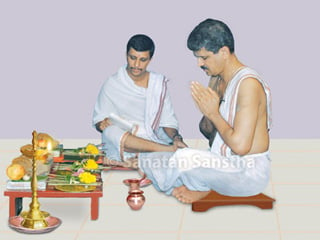
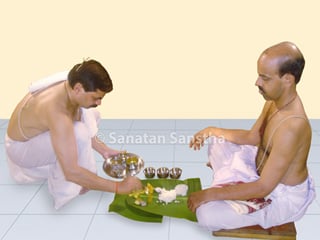
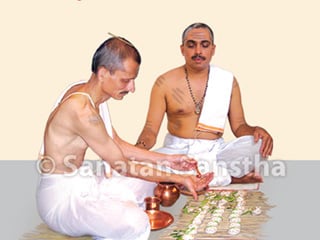
1. Significance and meaning:Trup’ means satisfying others. The word ‘Tarpan’ has been formed from the root word ‘Trup’. Offering water to God, Sages, ancestors’ soul and human beings and satisfying them through it is called tarpan.

2. Objective: The objective of performing tarpan is that God, deceased ancestors’ souls etc whose names are pronounced while performing Tarpan, should bestow happiness on us.

3. Types: Brahmayadnyang (performed during sacrificial fires), snanang (performed daily after bath), shraddhang (performed during Shraddha) are the various types of Tarpans that are part of the various rituals and should be performed during the respective occasions.

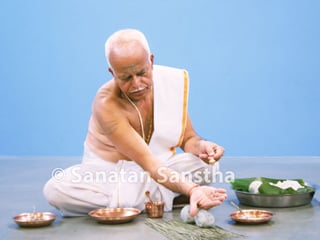
4. Method of performing Tarpan

  • Bodhayan has mentioned that ‘Tarpan should be performed at the riverside’. While performing Tarpan at the riverside, one should stand in the river so that the water level touches the belly button or one should perform tarpan by sitting on the banks of the river.

  • Tarpan for God and Sages should be performed by facing East and that for deceased ancestors’ souls it should be performed by facing South.

  • As per science, tarpan for God should be performed after doing ‘Savya’, that for Sages should be performed after doing ‘Nivit’ and for deceased ancestors’ souls after doing ‘Apasavya’.

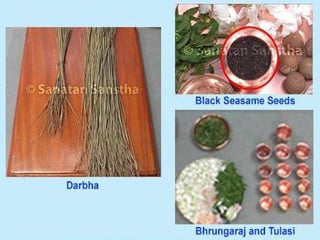
  • A dried grass twig (darbha) is necessary for performing tarpan. Tarpan for God is performed from the tip of the darbha, tarpan for Sages should be performed by folding the darbha in the middle, and tarpan for deceased ancestors’ souls should be performed from the tip and root of the two darbhas.

  • Offering of water (tarpan) to deities should be done using the finger tips, while offering of water to Sages should be done from the base of the little finger and the third finger and that to the deceased ancestors’ souls should be done through the mid of the thumb and the first finger of the hand.

  • Tarpan should be performed taking one handful (anjali) of water for each deity, two handful of water for Sages and three handful of water for deceased ancestors’ souls. In case of matrutrayi (mother-grandmother and great grandmother) three handful of water should be used and for other females ancestors’ souls one handful of water should be used for tarpan.(8)

(Original meaning of word ‘anjali’ is handful (‘onjal’). In this context, however, ‘giving one handful (anjali) of water for tarpan’ is to indicate that the tarpan should be given only once – compiler)

2.2. Pitru tarpan

1. Meaning: Offering of water to deceased ancestors’ souls (pitar) is called as Pitru tarpan. A Jivatpitruk is not allowed to perform Pitrutarpan.

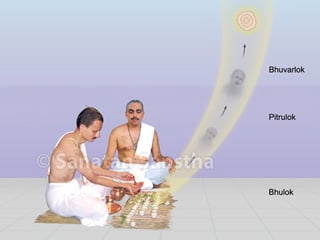
2. Why should it be done? Apart from expectation of Pinda and offering of food to priests (Brahmins) from its descendants, the deceased ancestors’ souls also expect offering of water (udak) from them.

3. Importance: By performing tarpan, the deceased ancestors’ souls not only get satisfied and leave us, but they also bestow long life, radiance, superior intellect (brahmavarchaswa), wealth, success and foodstuff (ability to digest the food consumed) on the host performing the tarpan and satisfies him too.

4. Pitrutirtha: When should it be done?

  • Tarpan for God, Sages and deceased ancestors’ souls should be performed regularly (daily). The daily ritual of tarpan should be accomplished in the early morning after having bath. If it is not possible to perform Shraddha for deceased ancestors’ souls daily, then one should at least perform tarpan.

  • Pitru tarpan should be performed on the day following the day on which Parvan Shraddha is performed.

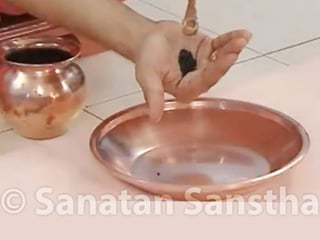
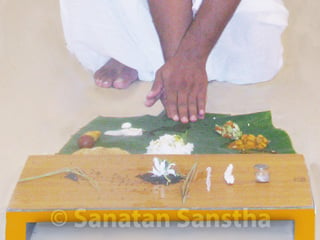
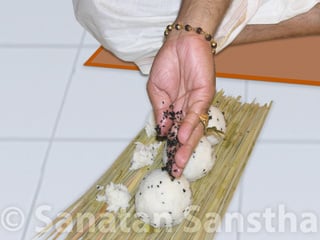
5. Tarpan of sesame seeds (tila tarpan): Sesame seeds should be used in the ritual of Pitru tarpan. Sesame seeds are available in two varieties, black and white. Black sesame seeds should be used for Shraddha. If sesame seeds are not available then gold or silver should be used.

  • Tila tarpan means offering sesame seeds mixed in water to the deceased ancestors’ souls.

  • Tila tarpan (as a part of Shraddha) should be offered to the same number of ancestors’ souls for whom the shraddha has been performed.

  • Tila tarpan is performed before Darsha shraddha and in case of annual shraddha; tila tarpan is performed on the following day of the shraddha. In case of any other shraddha, tila tarpan is performed just after performing the shraddha.

  • Tila tarpan is not performed during Nandi Shraddha, Sapindi Shraddha etc. (9)

6. Importance of performing tila tarpan

  • Sesame seeds are the favorites of deceased ancestors’ souls.

  • By usage of sesame seeds, the demons do not obstruct the ritual of Shraddha.

  • On the day of Shraddha, sesame seeds should be sprinkled all over the house, sesame seeds mixed in water should be given to the invited priests (Brahmins) and sesame seeds should be donated. - Jaiminiya Ghruya sutra (2.1), Boudhayan Dharmasutra (2.8.8) and Boudhayan Ghruya sutra

Reference: Shraddha (importance and scientific explanation) - Volume 1


For more information on this article read Sanatan's publication 'Shraddha (importance and scientific explanation) - Volume 1'.

Currently hard copy of reference book is available in -
Volume 1: Hindi, Marathi
Volume 2: Marathi


Sanatan Sanstha has undertaken mission of awakening righteousness and spreading spirituality in India and abroad. For further details contact: sanatan@sanatan.org

Learn about Shraddh though videos


Related Articles

» What is the importance of the ritual of Shraddha?
» What are three historically established phases of Shraddha?
» Why should every son perform ritual of Shraddha?
» What are the presiding deities and results of Shraddha?
» When can females perform Shraddha?
» When should the Shraddha be performed?

Rate this Article :

1

2

3

4

5

6

7

8

9

10
Poor Excellent
comment Post comment | Print Article Print Article | Send to Friends Send to Friends | Save as PDF Save as PDF

Comments

m.n.seetharaman, India (Bharat)
27 Sep 2007, 00:32
you r doing a great service,for the oppressed hindu community.we now need another SHIVAJI to save our culture from the modern day moguls -muslims,missionaries-leftists-our own pseudo secularists-last but not the least the so called secular media
Padam Kumar, India (Bharat)
03 Oct 2007, 09:53
give useful information about Nav -raatree
V. Shankar, India (Bharat)
30 Mar 2009, 12:16
My son is 14 year old. He lost his mother that's my wife. who will do shraddha for my wife? His grandfather is alive (mother's father). Please reply in detail.
Amit Sharma, India (Bharat)
05 Sep 2009, 02:15
You are doing great service to save hindu culture and traditions in this moderen time when most of hindu families forget their traditions and unable to tell these rituals to the next generation.
• Post your feedback
W.PRADIP, India (Bharat)
05 Sep 2009, 10:20
u r doing need of te society.WE AVE TO TAGET SCHOOLS/COLLEGES/CAFES MORE FOR THIS.SHALL WE ARANGE CAMPS/WOSOPS FO TESE ACTIVIIES.
Kantilal Dhanjee, South Africa
05 Sep 2009, 15:31
Thank you for providing such useful information. Most of our Hindu brethren do not know the Shraddha vidhi. This is a great way to disseminate knowledge on our religion. Once again Thank you very much.
A.KK. Sarkar, India (Bharat)
16 Sep 2009, 01:11
Thank you for the information provided. You are doing great service to Hundu Society. We are gradually fogetting our culture and values with the influences of modern life-style, specially the children. Regards.
Sudha Shet, India (Bharat)
26 Sep 2009, 23:32
Please display Stotras & mantras on the website
• Post your feedback
Col KR Mani, India (Bharat)
16 Jan 2010, 11:42


Sirs, kindly let me know as to why TIL is used profoundly in pitru tarppan or ancestral poojas? What is the basic book in which the importance of til is explained? kindly throw light if you know. thanks .(Read Importance of the substances used in Shraddhahttp://www.hindujagruti.org/hinduism/knowledge/article/importance-of-the-substances-used-in-shraddha.html and abut videos and other articles and books on this link- Editor)
Rohit Puranik, India (Bharat)
24 Jan 2010, 23:44
I am a student of VastuShastr.In modern days these basic facts or detail are over looked and due to this every one is losing a fortune.
Tarpan shall help you to unlock your lucky charm,and promote you to desired ambition.
There are few indicators like driiping of water from yor water tap,while eating unstable dish/moving frequently,while eating a drop or compleate spoonfool food dropingdawn,water while washing cloth is flowing at high speed which is not require are few indicators of PitruDosh -if you find any of these which are easy to understand other symptoms are complexin neture.Then it is adviseble for you to do daily TARPAN by this you shall give water to your Pitras and thy shall Bless you with their Great Powers.
SHUBHAM BHAVTU........
keshav, Trinidad and Tobago
04 Mar 2010, 18:01
wonderful article for the students of Santan Dharma, however, i'd like to know about the mantras and the format for shraadha. My interest lies in satisfying my ancestry. My parents and grand-parents departed this world many years. My fascination lies in knowing more abut them. all help would be highly appreciated.thanks i advance,
Gajanan N Bhat, India (Bharat)
26 Jul 2010, 00:07
The Sraddha karma should start from the Sankalpa, indicate mantras tobe told orallyalong with the handwork to be performed. Preparation should cover materials required.The end should be done with the tarpana and brahmanan aasheervachanam.
• Post your feedback

Feedback

Appreciate if you could help us to improve by sparing some time to fill up survey below.
All fields are required and information will be used only if we have any feedback for you.

Name:
Remember me?: 
Email:
Rate Usefulness
City:
Rate Complexity
Country:
Article Length
Message

You may enter 1500 characters