Call for enactment of a ‘Devasthan Land Protection Act’ to safeguard temple lands across Maharashtra
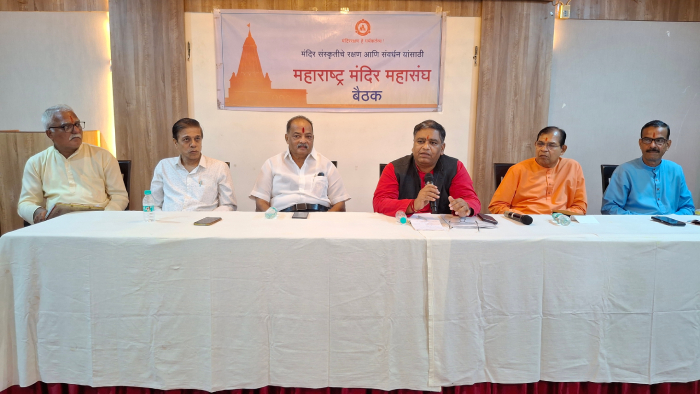
Ratnagiri, Maharashtra– The proposed ‘Devasthan Inam Abolition Act’ brought by the government is designed to usurp the lands of Hindu temples; the government must permanently scrap this law and instead immediately enact the ‘Devasthan Land Protection Act’ to keep temple lands secure, demanded Shri. Ramesh Shinde, the National Spokesperson of the Hindu Janajagruti Samiti. He was speaking at a special meeting of temple trustees recently organised in Ratnagiri by the ‘Maharashtra Mandir Mahasangh’. He also warned on this occasion that to ensure the enactment of the ‘Devasthan Land Protection Act’, a intense struggle would have to be raised by organising four and a half lakh temples across the state.
Key points shared by Shri. Ramesh Shinde
- If the government is indeed pro-Hindu, then it must enact laws for the benefit of Devasthans. In the state of Gujarat, the government enacted the ‘Anti-Land Grabbing Act’ in 2023 to keep Devasthan lands secure, which has provisions for strict punishment for encroaching upon temple lands. Furthermore, the responsibility to remove the encroachment and free the land rests with the government, not the temple. The government in Maharashtra should also make a similar law that safeguards Hindu interests.
- Multi-crore temple lands in Mumbai and other areas still receive nominal rent at the same rate since 1947. In line with the Waqf Board’s amended law, the Waqf Property Lease Rules, a ‘Model Rent Lease Act for Temple Lands’ should also be prepared for Hindu temple lands, so that temples also receive fair compensation for properties given on lease.
- According to the Devasthan Inam Abolition Act, the District Collector has been granted absolute powers to take final decisions on disputes regarding watans (hereditary land grants) and lands, and this cannot be challenged in court. This will leave room for corruption.
- Due to ‘Section 9’, temple roads, wells, lakes, and parking spaces will directly become the property of the government, and the temple will receive no compensation. If the law is meant for tenants (kuls), how did the government become a ‘tenant’ in this? Is it in line with the Constitution to exclude the Waqf Board from the law and make legislation solely for Hindu temples?
- Currently, only a stay has been granted against the proposed Devasthan Inam Abolition Act, and the deadline to register objections is until 15 August 2026. For this, all temples must unite and submit their stance in writing to local MLAs and Guardian Ministers.
Temple trustees must unite to reclaim the glory of temples – Sadguru Satyawan Kadam
Since ancient times, temples were the centres of our culture and economy. Today, temples are falling behind as centres of Dharmashikshan and worship. To reclaim this glory, all trustees need to come together and acquire spiritual strength by performing spiritual practice. In a democracy, the government does not take notice unless people unite. Due to the proper awareness raised during the meeting at Kunkeshwar, the tenants there accepted to give up their own rights over the land by taking the stance that ‘God’s land must remain God’s alone’; this is a major success of the awareness campaign run by the temple trustees.
Devasthan lands must remain registered only under the name of the Devasthans – Ravindra Surve, President, Gramdaivat Shri Dev Bhairi Mandir
The ‘Devrai’ (sacred grove) land of the Navlai temple, which falls under the Shri Dev Bhairi Devasthan, was preserved by ancestors for the protection of God; however, it has now been registered under the name of the government. In the future, it is necessary for these lands to remain secure for the facilities of devotees and the expansion of the temple. Even if the trustees change tomorrow, that land must permanently remain registered under the name of the Devasthan Trust itself.
Maintaining traditional possession will prevent Government acquisition! – Advocate Sanjesh Desai
Even if the ownership of ‘Devrai’ and pasture lands appears to belong to the government according to the revenue department records, their re-acquisition can be prevented if their traditional possession and usage is maintained accurately and visibly. While registering unregistered old Devasthans, the Government of Maharashtra has to be made a party, and it must be proved that the Devasthan is generations old. If the trustees maintain this usage, these lands can be properly utilised for the work of the Devasthan.
The meeting was compered by the Ratnagiri District Coordinator of the Maharashtra Mandir Mahasangh, Shri. Suresh Shinde. The introductory speech was delivered by the State Organiser, Shri. Sanjay Joshi. Temple trustees from Ratnagiri, Sangameshwar and Rajapur talukas, attended this meeting.