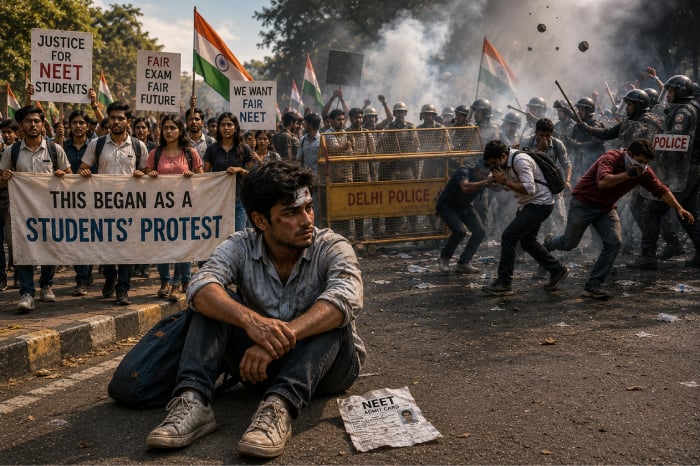
The NEET paper leak triggered widespread outrage across the country, quickly escalating into protests at Jantar Mantar in New Delhi, where demonstrators demanded the resignation of Education Minister Dharmendra Pradhan. Ladakh activist Sonam Wangchuk also undertook a hunger strike over the issue, receiving the support of the Cockroach Janta Party (CJP). Thousands of students from across India, seeking a fair and transparent admission process, rallied behind the movement, with many travelling to the national capital in the hope that their concerns about a fair and accountable education system would be heard.
When the movement ceased to be about students
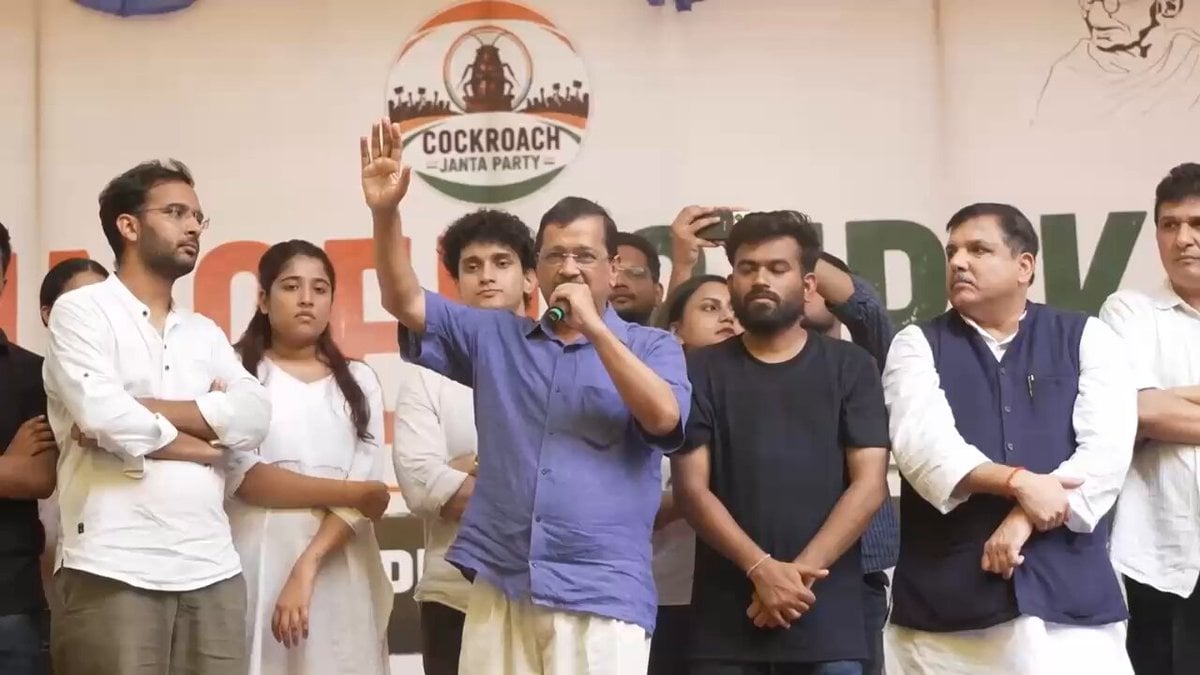
At its inception, the movement appeared to be a genuine expression of students’ frustration over an issue that directly affected their future. However, what began as a campaign for accountability soon underwent a striking transformation. The protest platform was gradually hijacked by anti-Hindu and anti-national elements, shifting the focus away from the concerns of NEET aspirants and turning the agitation into a stage for ideological grandstanding and political opportunism.
🚨 CJP के प्रोटेस्ट पर “हम देखेंगे” गाना क्यों गा रहे हैं?
महिला गा रही है – “बस नाम रहेगा अल्लाह का…”
फिर खुद ही कहती है – “ये लाइन राइट विंग को ट्रिगर करती है!”ये गाना पाकिस्तानी कवि ने जनरल जिया-उल-हक (मिलिट्री डिक्टेटर) के खिलाफ लिखा था।
भारत में कहाँ है डिक्टेटरशिप?… pic.twitter.com/e5yflZUgHQ
— Manoj Singh (@PracticalSpy) July 8, 2026
The transformation became increasingly apparent as the protest unfolded. Delhi University professor Nandita Narayan sang “Bas Naam Rahega Allah Ka…”, injecting a religious narrative into a students’ movement. Comedian Kunal Kamra soon joined the agitation and, under the guise of ridiculing the BJP, insulted Prabhu Shri Ram and Sita Mata. CJP spokesperson Vijeta Dahiya, known for his anti-Hindu rhetoric, used objectionable language against Vrindavan’s renowned saint, Premanandji Maharaj.
Hindu Gods mocked at CJP stage!
Kunal Kamra mocks Prabhu Shri Ram and Maa Sita, says
“Sita ke pati ka naam le lekar
Nita ke pati ka kaam kar rahe hai…” pic.twitter.com/b5b98Q3NEY— Megh Updates 🚨™ (@MeghUpdates) July 15, 2026
The stage was subsequently used by Aga Syed Ruhullah Mehdi an MP from Kashmir, to demand the reinstatement of Article 370.
The platform continued to be used to amplify anti-Hindu and anti-national rhetoric by prominent Hindu haters, including Kashmir separatist sympathiser Arundhati Roy, along with Prakash Raj, Shabana Azmi, and others. Political leaders, including Arvind Kejriwal and other AAP functionaries, also joined the agitation, seemingly eager to convert a students’ movement into an opportunity to revive their declining political fortunes.
प्रेमानंद महाराज को अपशब्द, कॉकरोच प्रवक्ता बेनकाब |
कॉकरोच जनता पार्टी के प्रवक्ता विजेता दहिया ने वृंदावन के प्रसिद्ध संत प्रेमानंद जी महाराज को लेकर अशोभनीय टिप्पणियां की हैं, जिसकी चौतरफा निंदा हो रही है।#vijetadahiya #premanandmaharaj #cockroachjantaparty @VijetaDahiya pic.twitter.com/fMkCzkc0OU
— ACN Bharat (@acnbharat) July 21, 2026
The original issue fading into the background
As the agitation gathered momentum, the original issue steadily receded into the background. A significant number of those occupying the protest site did not even appear to be students. Slogans were raised expressing support for Umar Khalid, who is currently in jail facing trial over alleged anti-national speeches.
Cockroach supporters are showing their true colours. After backing Umar Khalid, they are now abusing the Indian Army. Their so-called student movement stands completely exposed. pic.twitter.com/UCg7Hzdfbj
— Tajinder Bagga (@TajinderBagga) July 21, 2026
Protesters were reported to have made remarks directed against Hindus, Hindu beliefs and national institutions. Some protesters questioned the very existence of temples in India, while one protester publicly declared that her Muslim friends were better than her Hindu friends. Another participant was recorded using derogatory language against the Indian Army.
Videos from the protest site also showed participants hurling abusive and derogatory remarks at the Honourable Prime Minister Narendra Modi and Home Minister Amit Shah.
It just keeps getting more and more pathetic.
As a society, I think we have grossly underestimated the rot this reel culture has inducted in this generation. The fear of societal judgement is one of biggest reasons why we don’t do certain things, pic.twitter.com/r2KDytM11p
— Maj Manik M Jolly,SM (@Manik_M_Jolly) July 24, 2026
Cricketer Virat Kohli became another target simply because he chose not to endorse the agitation, even though numerous other celebrities had similarly remained silent. The selective nature of this criticism appeared to stem from Kohli’s unapologetic expression of his Hindu faith and his association with Sant Premanandji Maharaj.
Some protesters openly declared that their objective was not confined to the examination controversy but extended to creating widespread unrest and bringing down the Government, drawing parallels with developments in Bangladesh and Nepal.
The entire CJP protest is running in rented protesters.
Look how people are being brought in for money.
First he said, “I study in a B.A. course”… then when he was asked about his subject, he got stuck and said, “I’m not a student.”
Dimple Yadav had said in front of the… pic.twitter.com/Tot50CO4bK
— Oxomiya Jiyori 🇮🇳 (@SouleFacts) July 24, 2026
By this stage, the students’ movement had totally been hijacked by anti-Hindu and anti-national elements. Narratives perceived as anti-Hindu and anti-national were celebrated as acts of courageous dissent and aggressively amplified across social media. Those who questioned the changing character of the agitation or challenged its rhetoric were dismissed as ‘Andhbhakts’, ‘BJP agents’, ‘members of the BJP IT Cell’, or simply branded as ‘bots’.
External attempts to fuel the unrest
Delhi Police stated that it had identified and blocked more than 400 Pakistan-based social media handles spreading misinformation, rumours and edited videos to exploit the agitation and provoke Indian youth. According to the police, several of these accounts had previously been active during Operation Sindoor, raising concerns that external actors were attempting to inflame public sentiment and deepen unrest.
How can @Swiggy get orders from Bangladesh?
Is that possible? pic.twitter.com/JkOz8DL3il
— Kreately.in (@KreatelyMedia) July 22, 2026
Alongside the online campaign, reports also emerged of protesters receiving food deliveries funded from abroad. Media reports stated that orders were placed from countries including the UAE and Qatar, and a viral video showed a delivery partner stating that an order had been placed from Bangladesh.
These developments fuelled further speculation over the extent of external involvement in the agitation. While these allegations are yet to be judicially established, they added another dimension to the growing unrest during the protests.
When the streets turned violent
जंतर-मंतर हिंसा में घायल पुलिसकर्मियों ने सुनाई आपबीती: ‘हम पर ईंट-पत्थरों से हमला हुआ, हमे आटे की तरह गूँध दिया, भीड़ ने घेरकर पीटा’ pic.twitter.com/EmLXyBtvvo
— Royal Bulletin (@RoyalBulletin) July 23, 2026
On 20 July, protesters were urged to march towards Parliament. What followed was no longer a peaceful demonstration. As the procession advanced, clashes broke out with the police, culminating in a lathi charge after protesters allegedly attacked police personnel, and vandalised public property. Numerous students, as well as police personnel, sustained injuries during the confrontation. Journalists who questioned protesters about the changing direction of the movement or challenged their stated objectives were also assaulted by the protesters.
Where is @IndEditorsGuild now? https://t.co/9dDTNjFl70
— Alok Bhatt (@alok_bhatt) July 21, 2026
Dharmendra Pradhan resigns
Finally, on 25 July, Education Minister Dharmendra Pradhan tendered his resignation, accepting moral responsibility for the controversy. In his resignation letter, he stated that he did not wish anti-national forces to exploit the issue further and reiterated that the interests and future of the nation’s students must remain paramount.
Dharmendra Pradhan resigns as India’s Education Minister. President Murmu accepted the resignation on 25 July. Pralhad Joshi takes charge. Hours later, the Cockroach Janta Party ended its protest after the government accepted its demands.
Full story: https://t.co/oMjse3vRtp pic.twitter.com/tx8Z2rotDX
— NRI Affairs (@NRI_Affairs) July 26, 2026
The resignation came after days of engagement between the Government and the protesters, even as the agitation itself had drifted from its original objective. The Government had invited representatives of the movement for discussions, and Prime Minister Narendra Modi addressed the nation’s youth through an Instagram video, acknowledging the anxiety surrounding the paper leak and assuring students that those responsible would face the strictest possible action.
With Pradhan’s resignation, the principal demand around which the agitation had been mobilised had, in effect, been fulfilled.
Who paid the price?
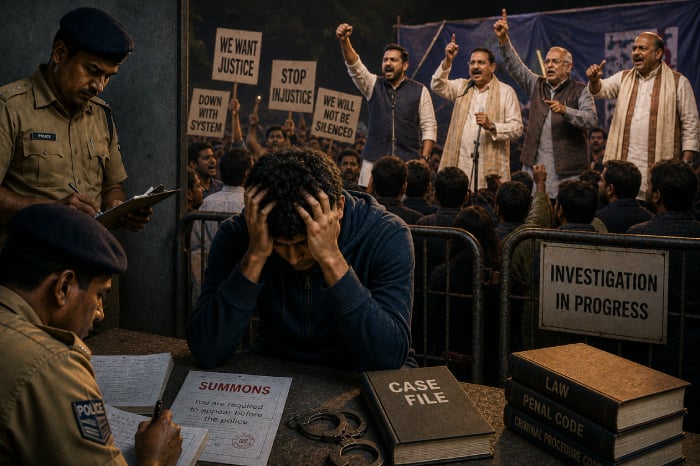
The resignation of Dharmendra Pradhan was celebrated by the CJP as a victory for its resilience and determination. Ironically, when the confrontation reached its peak, it was largely the students who remained on the streets. Many of the prominent personalities who had addressed or publicly supported the agitation were nowhere to be seen on the front lines. CJP spokesperson Vijeta Dahiya was reportedly seen at a local food outlet having a burger while protesters clashed with the police. CJP Founder Abhijeet Dipke was likewise absent from the protest site. Several public figures who had occupied the stage, including Prakash Raj, Shabana Azmi, Arundhati Roy, were also conspicuous by their absence when the situation turned violent.
As the protests descended into violent clashes with the police, it was neither the politicians nor the celebrities who bore the consequences of the agitation. While many of those who had mobilised or publicly supported the agitation were no longer present, the students were left to face the immediate consequences. Many suffered injuries during the clashes. Several students were detained by the police, placing their academic careers and future employment prospects at risk.
Lessons from the NEET protests – What every young Indian must remember?
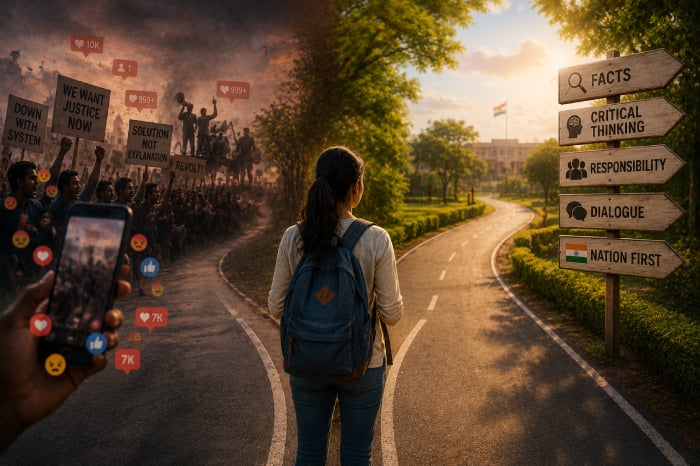
With the resignation of the Education Minister the principal demand of the agitation had, in effect, been addressed. Yet the events at Jantar Mantar raised questions extending far beyond the NEET controversy. They offered lessons not only about protest, but also about social media, political influence and the responsibilities that accompany democratic participation.
Every generation witnesses moments of public unrest. Protest is a legitimate democratic right, and young people have every reason to speak out when they believe an injustice has been committed. At the same time, every protest offers lessons that extend far beyond the issue at hand. The events surrounding the NEET agitation offer several such lessons.
1. Think independently; do not outsource your judgement
Passion is admirable, but it must always be guided by reason. Before joining any movement, understand its objectives, its leadership, and the direction in which it is headed. If a protest begins to deviate from its original purpose or starts promoting agendas that you do not subscribe to, have the courage to question it, or walk away. Independent thinking is the hallmark of responsible citizenship.
2. Do not let FOMO dictate your conscience.
Fear of missing out (FOMO) has become one of the defining traits of the social media age. As support for the protest spread across social media, several influencers and public personalities appeared eager to associate themselves with the movement, often without examining what it had evolved into. Popularity, trends and online engagement are fleeting. Your credibility and judgement will endure long after a hashtag has stopped trending.
3. Real life is not a social media reel
Social media rewards outrage, provocation and spectacle. Real life does not. Abusive language, hate-filled slogans and reckless conduct may attract views, likes and followers for a few days, but the consequences are real and often long-lasting. Police investigations, legal proceedings and reputational damage do not disappear when the next trend arrives. Before saying or doing something in the heat of the moment, ask yourself whether it is worth carrying the consequences long after the social media applause has faded.
4. Nation first
No democratic demand is strengthened by insulting a religion, abusing national institutions and elected government representatives, or ridiculing the faith of others. If a movement begins to endorse anti-national rhetoric or targets a particular religion for reasons unrelated to the issue being protested, it is time to reconsider one’s participation. Parents and teachers have an equally important responsibility—to cultivate critical thinking, emotional maturity and a sense of national responsibility, so that young people learn to distinguish between legitimate dissent and ideological manipulation.
5. It is the students, not the so-called leaders who bear the consequences
When the cameras disappear and the crowds disperse, politicians return to politics, activists resume their campaigns and celebrities move on to their next cause. Students, however, are left to deal with the consequences of their actions. An arrest, a criminal case or an FIR can cast a long shadow over future education, employment and professional opportunities. Before stepping into a confrontation, every student must ask a simple question: Who will bear the consequences tomorrow?
Young Indians are not freedom fighters battling colonial rule. They are citizens of a free nation seeking solutions to genuine public issues. Such issues deserve to be addressed firmly, democratically and with maturity, by not allowing themselves to become instruments in someone else’s political or ideological battle.
Conclusion
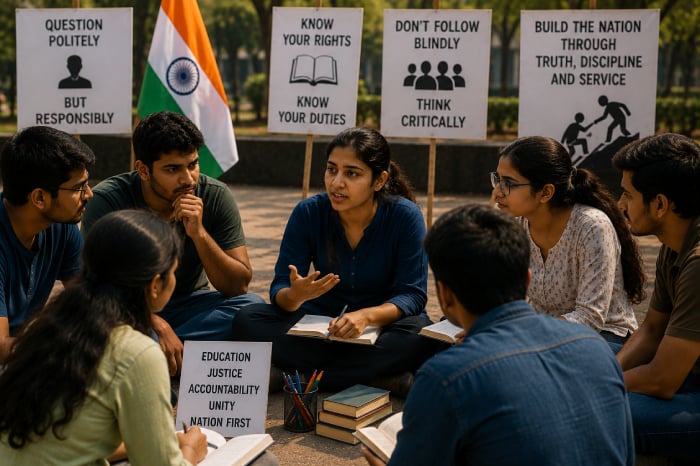
The NEET controversy may eventually fade from public memory, but the lessons it offers should not. The most enduring lesson is that every young Indian must learn to think independently before becoming part of any public movement. A genuine cause can lose its direction if it is overtaken by political or ideological interests, and those who pay the highest price are often not the so-called leaders, activists or celebrities, but the ordinary students who place their trust in them.
Democracies require informed, thoughtful and responsible citizens. Every protest should strengthen society rather than divide it, and every demand for justice must be guided by reason, responsibility and a commitment to national interest.