The Maharashtra government has put forward a draft legislation — the ‘Maharashtra Devasthan Inam Abolition (Draft) Act, 2026’, that proposes to overhaul the legal status of lands traditionally held by Hindu temples and religious institutions across the state. The move has triggered sharp opposition from temple trustees, priests and Hindu organisations, led by the Maharashtra Mandir Mahasangh, which has warned of a statewide agitation if the bill is passed in its current form.
#Bill_Against_Temple_Land
⚠️ महाराष्ट्र सरकार द्वारा प्रस्तावित “देवस्थान इनाम निर्मूलन कानून’ हिंदू मंदिरों और देवस्थानों की भूमि पर गंभीर संकट बनकर सामने आया है।
अधिक जानकारी 👇🏻
🔗 https://t.co/Kk1fUh6RzU
🔗 https://t.co/MaeFY2uJ1LSign Petition: 👇🏻
Thttps://t.co/ThFe39FqFr pic.twitter.com/65oongnHQJ— Mandir Mahasangh (@mandirmahasangh) May 25, 2026
What Are Inam lands?
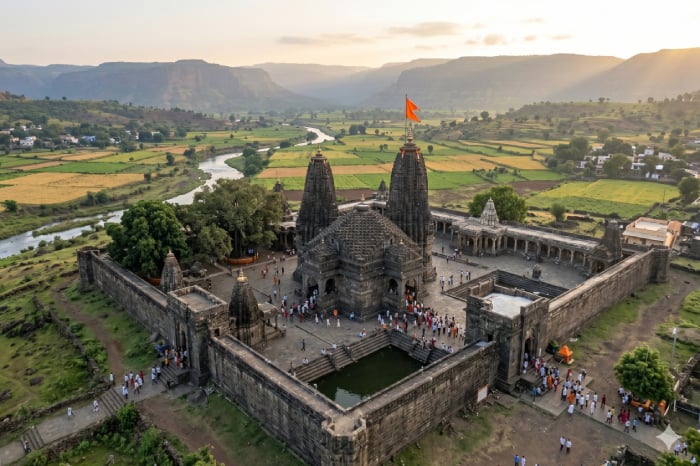
Centuries ago, kings and rulers across India used to grant land to temples, mutts and religious institutions as a form of royal endowment. These lands, known as Devsthan Inams, were given so that temples could sustain their daily operations — paying priests, running community kitchens, charitable activities, conducting annual festivals, and maintaining the institution. Crucially, these grants came with an exemption from paying land revenue to the government.
Over generations, these lands became the financial backbone of thousands of temples across Maharashtra. Many of these grants trace back to the Maratha empire era, including endowments made by Chhatrapati Shivaji Maharaj himself.
What does this Act propose to do?
In simple terms, the Act seeks to abolish the existing legal status of these temple lands and replace it with a new framework. Here is what it proposes:
1. Wiping out existing protections: Section 3 of the draft cancels all existing rights, privileges and legal protections that currently attach to Devasthan Inam lands. Every legal safeguard that temples currently enjoy over these properties would be extinguished from the day the Act comes into force. Additionally, all Devasthan lands would become liable to pay land revenue to the government going forward, something they were historically exempt from.
2. Transferring land to occupants: Section 4, arguably the most controversial clause, proposes to grant “Occupant Class-I” rights to tenants, mirasdars, cultivators and other occupants of temple lands. In plain terms, Occupant Class-I is one of the strongest forms of land ownership recognised under Maharashtra’s revenue laws. Granting this to current occupants would effectively hand them permanent ownership of land that has belonged to temples for centuries.
3. Regularising past encroachments: The draft allows people who have been illegally occupying Devasthan land continuously since before 1 January 2011 to be regularised, that is, to have their illegal occupation converted into legal ownership if they pay the market value of the land. Even more strikingly, people occupying temple land in village residential areas (Gaothan areas) before that date may receive ownership rights without paying anything at all. This amounts to directly rewarding and legalising past illegal occupation.
4. Government seizure of non-agricultural temple lands: Section 9 of the draft proposes that any Devasthan land not in the direct possession and use of the temple itself, or land being used for non-agricultural or construction purposes, will be taken over by the government. This includes natural features within temple land boundaries — riverbeds, water bodies, tanks, canals, mines and quarries. In practical terms, this means that a large portion of temple landholdings could be seized by the state simply because the temple is not physically using every parcel directly. This provision could result in sweeping government acquisition of temple properties across Maharashtra.
5. Criminal penalties for future encroachments: Sections 7 and 8 do propose strict action against future encroachments — two to five years of imprisonment and fines up to the market value of the land, with District Collectors empowered to carry out summary evictions. However, there is a glaring contradiction — the same law that promises to punish future land grabbers simultaneously legalises everything that happened before 2011.
6. Unchecked powers to revenue officials: Under the draft, all key decisions such as determining occupancy rights, classifying holders as authorised or unauthorised, and ordering evictions, vest exclusively in revenue officials such as Tehsildars and District Collectors. Aggrieved parties may appeal to the Divisional Commissioner within 60 days, and thereafter to the State Government within 90 days. However, at no stage does the process involve judicial scrutiny; the entire chain of decision-making remains within the executive machinery. This effectively places century-old temple properties at the mercy of individual bureaucrats, with no independent oversight or judicial check.
The Waqf problem: Why are temple lands being treated differently?
One of the biggest objections raised by temple organisations is that this law specifically targets Hindu temple lands while leaving similar properties of other religious communities completely untouched.
The draft explicitly exempts properties governed by the Waqf Act, 1995 — meaning lands held by Waqf Boards are entirely outside the scope of this legislation. No occupant of Waqf land gets ownership rights under this bill. No Waqf land faces restructuring or transfer provisions.
In fact, temple organisations have pointed to a 2016 Maharashtra government circular that directed revenue authorities to mark Waqf properties as non-transferable in land records, a protection that no equivalent government circular extends to Hindu temple lands.
The question being asked is straightforward — if the state can protect Waqf properties from transfer and encroachment, why is it simultaneously creating a mechanism to transfer Hindu temple lands to private individuals? Who is benefitting from this?
Why is the Maharashtra Mandir Mahasangh opposing this Act?
⚠️ प्रस्तावित “देवस्थान इनाम निर्मूलन कायदा” म्हणजे हिंदू मंदिरांच्या अस्तित्वावर घाला !
ज्या देवस्थान जमिनींवरून शतकानुशतके पूजा, उत्सव, धर्मकार्य चालत आले, त्या जमिनी आता कुळे व वहिवाटदारांच्या नावावर करण्याचा प्रयत्न सुरू आहे.
मंदिर भूमिहीन झाली तर धर्मपरंपरा आणि संस्कृतीही… pic.twitter.com/OtQxQdAvSm
— Sunil Ghanwat 🛕🛕 (@SG_HJS) May 25, 2026
The Mandir Mahasangh has raised objections on the following grounds:
1. The government has no right to legislate this in the first place: Under well-established Indian judicial doctrine upheld repeatedly by the Supreme Court and various High Courts, temple property legally belongs to the Deity, not to the trustees and certainly not to the state government. The Deity is recognised as a juristic person ( a legal living entity) with enforceable property rights. The Mahasangh argues that since the government does not own these lands, it has no legal authority to pass a law transferring them to someone else.
2. It opens the door to land mafias and builders: By legalising old encroachments and granting strong ownership rights to current occupants, the law creates a straightforward pathway for organised land grabbers to benefit. Temple organisations argues that politically connected encroachers, builders and land mafias have already occupied portions of temple lands across Maharashtra, and warn that this law would hand them permanent legal title over such properties.
3. It threatens the financial survival of temples: Temple lands are not just historical assets, they are the primary source of income for hundreds of smaller temples across Maharashtra. Salaries of priests, upkeep of temple premises, conduct of festivals and community welfare programmes are all funded from the revenue these lands generate. Transferring large portions of this land to private occupants would cut off that income, potentially forcing many smaller temples to shut down or drastically curtail their activities.
4. It violates constitutional guarantees: The Mahasangh argues the bill violates Article 25 (freedom of religion), Article 26 (right of religious institutions to manage their own affairs) and Article 300A (right to property) of the Indian Constitution.
5. Courts locked out, revenue officials get unchecked power: Section 14 of the draft Act explicitly bars Civil Courts from intervening in any matter that falls under this legislation. This means that if a District Collector or Tehsildar makes an arbitrary or incorrect decision regarding temple land, whether about occupancy rights, eviction, or transfer, the affected temple or its trustees have no recourse in a court of law. The only options available are an appeal to the Divisional Commissioner, and beyond that to the State Government. both of which are part of the same executive machinery that made the original decision. This has been described as administrative high-handedness, which gives sweeping, unchallengeable authority to bureaucrats over properties held sacred for centuries, with no judicial oversight as a check.
Demands of the Maharashtra Mandir Mahasangh
🛕 यदि मंदिरों की भूमि छिन गई, तो आने वाली पीढ़ियाँ केवल इतिहास में समृद्ध देवस्थान देख पाएंगी।
यह केवल जमीन का मुद्दा नहीं —
यह हिंदू धार्मिक अधिकारों, सांस्कृतिक विरासत और आर्थिक स्वायत्तता की रक्षा का प्रश्न है।बिल्डर लॉबी और निजी हितों से मंदिरों को बचाना होगा।
🚩 Save… pic.twitter.com/RHY2NkY0dH
— Sunil Ghanwat 🛕🛕 (@SG_HJS) May 25, 2026
The organisation has submitted a formal memorandum to Chief Minister Devendra Fadnavis with the following demands:
- Immediate and complete withdrawal of the Draft Act
- All Devasthan lands to be explicitly marked as non-transferable in revenue records
- A dedicated and stringent law specifically to prevent grabbing of temple lands
- An SIT (Special Investigation Team) probe into past encroachments on temple lands and allegedly forged revenue records
- Fast-track courts to resolve all pending temple land disputes within six months
The Mahasangh has warned that if the government ignores these demands and proceeds with the legislation, it will launch a statewide agitation mobilising temple trusts, priests, devotees and Hindu organisations across Maharashtra.
Where does the Draft Act stand now?
The Draft Act is currently open for public consultation. Citizens, temple organisations and legal experts can file their objections and suggestions through divisional commissioners’ offices. The last date to do so is 5 June 2026.
After that deadline, the state government will decide whether to revise the draft based on the feedback received, delay it further, or push it through the legislature in its current form.