In today’s digital era, numerous means of entertainment are available. Through social media, OTT platforms, YouTube, and live shows, comedians have found an opportunity to reach millions of people. Humour is an essential part of human life. It relieves stress, cheers the mind, and provides a healthy perspective to society. Unfortunately, however, the standard of humour is visibly declining at a rapid pace today. Many so-called comedians are turning obscenity, vulgar language, religious mockery, personal insults, and the disregard of social values into synonyms for humour.
What is the true purpose of humour?
The purpose of humour is to bring joy to society, cast a sensitive eye on the contradictions of life, and inspire positive thoughts. In the rich tradition of Bharatiya literature and theatre, humour was used for social reform. Wit and wit-cracking do not mean insulting an individual, religion, culture, or social values.
Today, the situation appears quite the opposite. Instead of simple and decent humour, obscene remarks, double-entendre dialogues, swear words, and statements that hurt religious sentiments are being made more popular. Because of this, society’s understanding of humour is becoming distorted.
The negative impact on the younger generation
Through social media, such programmes have the greatest impact on young people. When popular artists use vulgar language, many youngsters begin to view it as a symbol of modernity and freedom of expression.
As a result:
- The culture of decent conversation is weakened.
- Respect towards women declines.
- The mockery of religious and cultural values begins to seem normal.
- Social sensitivity diminishes.
- A distorted mindset is encouraged in the name of entertainment.
A few recent controversies
In recent years, several stand-up comedy shows have presented humour on topics linked to social sensitivity, moral boundaries, and cultural values. In the name of entertainment, statements and scenarios are repeatedly used to which various sections of society have raised serious objections.
The Pranit More case
1. A video from a show by comedian Pranit More went viral on social media. During an interaction with the audience (crowd work), a young man from Gurugram described his dating experience, stating that he had spent ₹370 on biryani for a young woman. He then implied that, in exchange for the money spent on food, he expected a physical relationship or sexual favours from her. This statement was met with laughter and jokes on stage, and the video was later circulated on social media.
Stand-up comedian Pranit More mocked on girls when a person told that he served a girl biryani of ₹370.
₹370 Ka Biryani Khila Di Toh Vasool karne Ka Haq Mil Gya.
Yahi Soch Problem Hai… pic.twitter.com/YBN3PrYGfV
— Shailesh UP60 (@Shailes34135660) June 7, 2026
The root cause of the controversy was not merely the ₹370 biryani, but the mindset suggesting that spending a bit of money on a woman gives one a right over her body or her choices. Instead of stopping or countering the objectionable remark, Pranit More reacted by laughing at it. Many people highlighted this as an example of a mindset operating against women’s dignity, consent, and respect.
2. In the very same show by Pranit More, highly obscene and objectionable remarks were made regarding the private parts of bodies donated for medical science, concerning Ms Sejal Pawar from the KEM Hospital in Mumbai. These remarks were treated as a joke during the programme. When its video circulated on social media, various sections of society strongly criticised it. Many described it as an insult to the medical field and to the sacred service of body donation.
This is Sejal Pawar a doctor in Mumbai
– She came to Pranit More show & joked about how she and her friends check D sizes of dead bodies
– Then she joked how they cut main part of male bodies at the end.
– Degrading Human Bodies in Death
-Rs 370 Biryani Guy Himanshu Jangra was… pic.twitter.com/zZ41ghcHlJ— Rosy (@rose_k01) June 10, 2026
This incident became an example of how broad the social impact can be when a mindset normalising sexual coercion are presented as entertainment by crossing the boundaries of humour.
Controversies surrounding Ranveer Allahbadia’s programmes
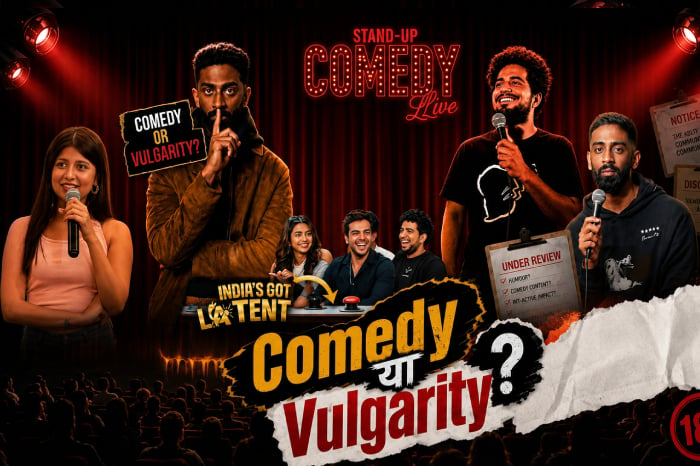
From time to time, allegations have been made against certain programmes and content by comedian Samay Raina, specifically his YouTube show India’s Got Latent 2024-25, stating that they employ obscene language, vulgar remarks, and violate social decorum. In an episode of the show in February 2025, YouTuber Ranveer Allahbadia asked a contestant a highly objectionable question relating to parents and sexual relationships. After this clip went viral, it triggered a furious nationwide reaction. Complaints and FIRs were registered in several states. Investigations commenced at various levels, including in Maharashtra and Assam. Following this, Samay Raina removed all episodes of the show from YouTube.
In many episodes of the show, sexual themes, double-entendre dialogues, abuses, and personal remarks were made the primary basis of the humour. Critics state that crossing these boundaries in the name of entertainment is leading the younger generation down the wrong path.
Mockery of Hindu places of worship by Munawar Faruqui
The programmes of Munawar Faruqui have also repeatedly courted controversy regarding religious sentiments and cultural symbols. Various organisations alleged that some of his statements mocked religious beliefs. In one show, Munawar ridiculed Mata Sita and Prabhu Shri Ram.
Can freedom of expression be absolute?
Freedom of expression is a vital right in a democracy; however, every right comes attached to a responsibility. Popularity gained by hurting someone’s faith, culture, morality, or social sensitivities cannot build a healthy society.
If regulatory systems exist for films, serials, and other visual media, then serious thought must also be given to ensuring a code of conduct and accountability for public comedy shows broadcast on a large scale.
What should society do?
To develop a healthy culture of humour in society:
- Reading literature should be encouraged.
- The organisation of drama, elocution, and cultural competitions should be increased.
- A sense of sanskars and social responsibility should be developed among the youth.
- Decent and thought-provoking comedians should be encouraged.
- The tendency to treat obscenity and insults as the benchmark of entertainment must be opposed.
True humour is that which makes a person think whilst making them laugh. Wit that unites society is the finest wit; not that which tears society apart.
Shiv Sena MLC Dr Manisha Kayande demands strict action on stand-up comedy shows promoting obscenity
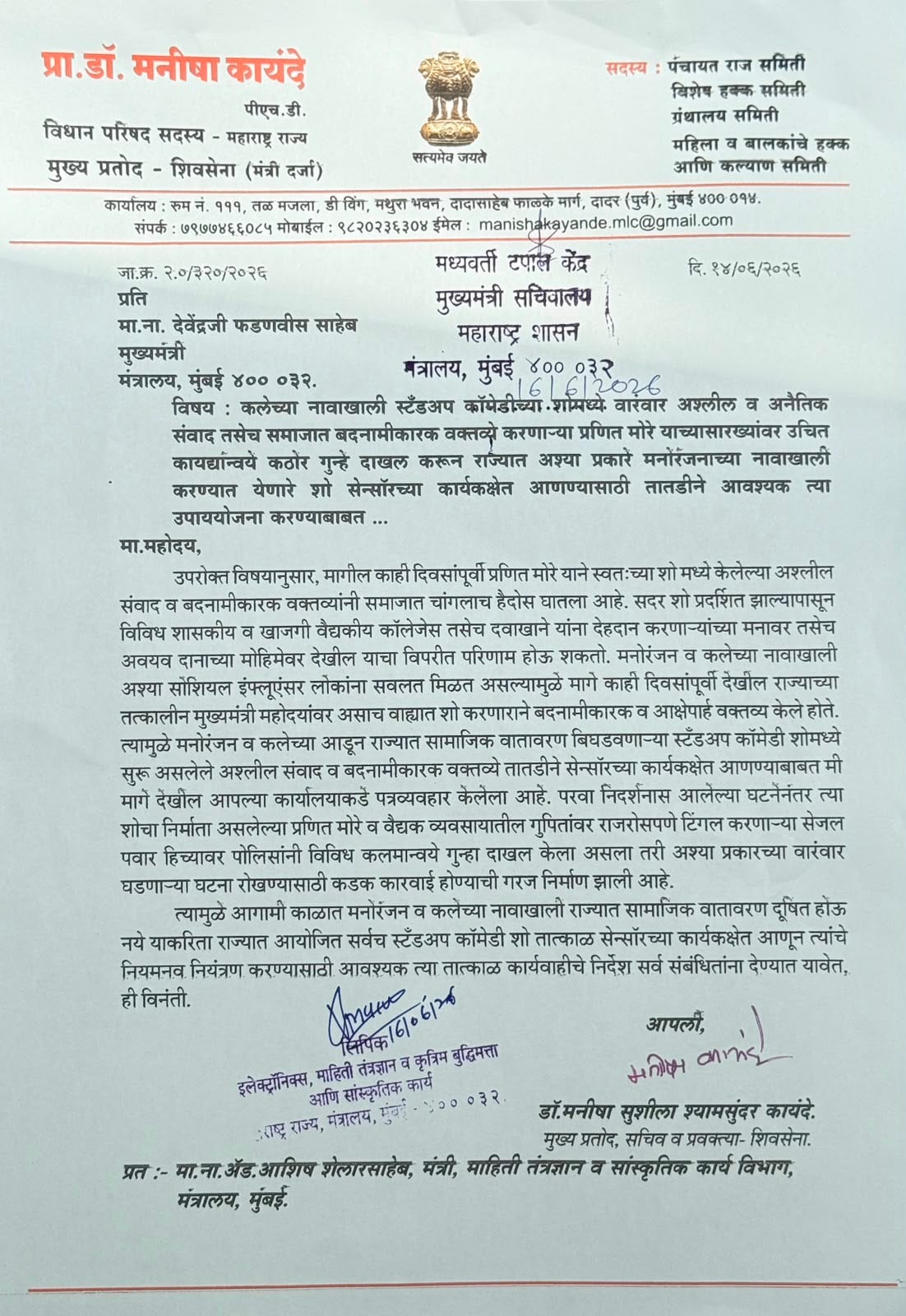
In this context, Shiv Sena Legislative Council Member and Chief Whip, Dr Manisha Kayande, has written a letter to the Chief Minister of Maharashtra, Devendra Fadnavis. She has demanded that strict controls be placed on stand-up comedy shows containing obscene and immoral dialogues, and that such programmes be brought under the requirement of prior approval from the Censor Board.
🚨 Demand for Action on Obscene Stand-Up Comedy Shows
Shiv Sena MLC @KayandeDr has urged the CM to make pre-censorship mandatory for stand-up comedy shows that promote obscenity.
🔹 Derogatory remarks on organ donation can harm life-saving awareness campaigns.
🔹 Vulgarity is… https://t.co/Dbb5lp3hlg pic.twitter.com/1PyQdINTPr
— Sanatan Prabhat (@SanatanPrabhat) June 17, 2026
She stated in her letter that:
- The obscene remarks made in Pranit More’s programme could have a negative impact on society.
- The image of social campaigns such as organ donation and body donation could suffer damage due to this.
- Such programmes broadcast on social media are promoting obscenity in society.
- Merely registering offences in individual cases will not provide a permanent solution to the problem.
- A system of regulation and pre-screening is essential for such programmes organised in the future.
Dr Manisha Kayande has demanded that the state government formulate the necessary policy in this regard and issue directions to the relevant departments. She has also sent a copy of the letter to the State Minister for Cultural Affairs.
Humour is the mirror of society, but when that very humour becomes a medium for obscenity, insults, and distortion, its consequences can be far-reaching and severe. Today, the need of the hour is to establish a balance between entertainment and social responsibility. To save the rich tradition of wit, artists, audiences, and the administration will all have to play their parts. Only then will the creation of a healthy, sensitive, and value-oriented society be possible.