‘Stop paid darshan, save temples’ – Memorandum submitted in Battis Shirala, Sangli

Sangli. Maharashtra – A memorandum demanding the immediate discontinuation of the ‘paid darshan’ service across all state-controlled temples in Maharashtra, including those in Nashik and Tuljapur, was submitted by the Mandir Mahasangh to Tehsildar Shailaja Khot in Battis Shirala.
The event saw the presence of Shri. Prasad Kulkarni (Coordinator, Kolhapur District Mandir Mahasangh), along with many devout Hindu activists, namely, Ashok Maskar, Pravin Patil, Sharad Naikwadi, Bajrang Kumbhar, Ajit Kumbhar, Jitendra Pandit, Pravin Patil, Dhondiram Mulik, and Santosh Bandivdekar, among others.
Other demands made on the occasion
- An immediate ban should be imposed on the book ‘Shivaji Kon Hota?’ (Who was Shivaji?) authored by Comrade Govind Pansare.
- Stringent action must be taken against the ongoing ‘corporate jihad’ and religious pressure tactics within multinational corporations.
April 17, 2026
Mandir Mahasangh also calls for ending political appointments in temple administration

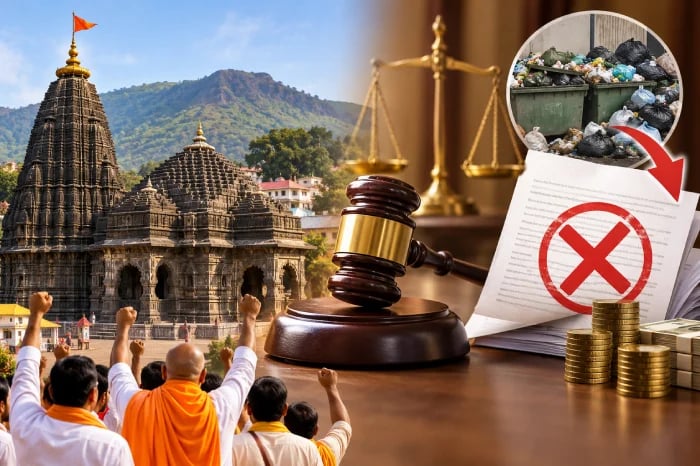
Nashik, Maharashtra – In the case of the financial exploitation of devotees at the Trimbakeshwar Temple, the police have arrested temple trustee Purushottam Kadlag, who is also the state youth working president of the NCP (Sharad Pawar faction), along with three others.
It has come to light that, despite a provision to procure an official pass for ₹200, devotees were lured with promises of completing darshan within 10 minutes and were allegedly charged exorbitant amounts ranging from ₹3,000 to ₹12,000. A similar pattern has been observed at the Shri Tulja Bhavani Temple in Tuljapur, where special darshan is provided for a ₹200 ‘pass’. During Navratri, this same pass costs anywhere between ₹300 to ₹1,000. Several devotees have complained regarding these additional charges for darshan.
In reality, the very concept of a ‘paid darshan service’ is deeply flawed, as it creates inequality among devotees based on financial capacity. What are those devotees supposed to do who travel from far-flung areas and do not have money? Depriving them of darshan due to a lack of funds is an insult to their faith and a violation of the fundamental religious rights granted by the Constitution. In the eyes of God, the rich and the poor are all equal; therefore, the system of darshan should also be equal for everyone. Is a temple merely a commercial establishment or a shop meant to increase revenue? Furthermore, the tendency for the black-marketing of such passes is also increasing. Therefore, the ‘paid darshan’ facility in all government-controlled temples across the state, including Nashik and Tuljapur, must be stopped immediately.
This demand has been made by Shri. Sunil Ghanwat, the National Organiser of the Mandir Mahasangh.
Stop political appointments in temple administration
When temples fall under the control of the government or committees with political appointees, commercialism dominates over devotion. This incident in Trimbakeshwar is a direct consequence of the government takeover of temples. In a land that believes in ‘Atithi Devo Bhava’, it is extremely unfortunate that a racket to exploit devotees is being run by the temple trustees themselves.
There must be a thorough investigation into this ‘paid darshan’ matter to find out who else is involved. To prevent such incidents in the future, it is necessary to appoint a ‘true devotee’ rather than an office-bearer of any political party as a trustee in temples. The Mandir Mahasangh has demanded that appropriate amendments be made to the rules of the temples in this regard.