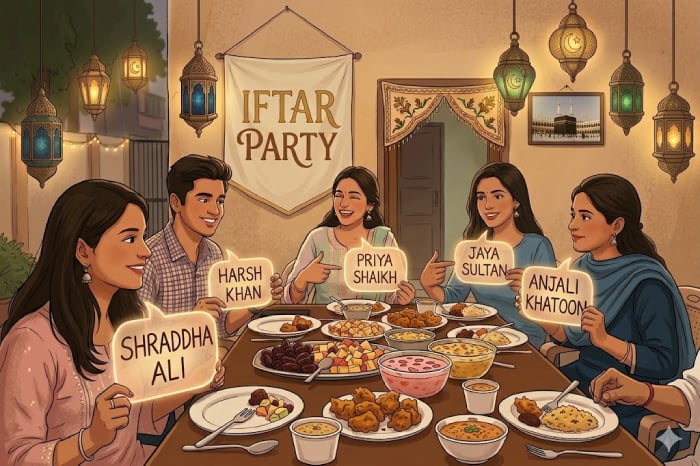
A recent viral trend during Ramzan Iftar parties has taken social media by storm. Young Hindu girls and boys attending Iftar parties hosted by Muslim friends are playfully adopting Muslim surnames. In widely shared Instagram reels and videos, participants introduce themselves as Harsh Khan, Jaya Sultan, Anjali Khatoon, Priya Shaikh, Shraddha Ali and similar combinations. These clips are framed as innocent fun, promoting “Hindu-Muslim bhaichara,” friendship, and unity during the month of Ramzan. Supporters hail it as a shining example of secularism and interfaith bonding.
This Muslim Insta influencer:
>Invited Hind Friends to her Iftar party
>Asked them to introduce themselves
>Hindu girls and boys giving names with Muslim surnames 🤡With this, 20% of the entire Maksad is completed. These H youngsters are completely out of touch with reality. I… pic.twitter.com/1buBgma4Ux
— Chota Don (@choga_don) March 15, 2026
Before we rush to celebrate this as progressive secularism, a fundamental question demands an honest answer – Are Muslims equally willing to reciprocate during Hindu festivals? Can we realistically picture a group of Muslims at a Diwali gathering, Holi celebration, or Ganesh Chaturthi introducing themselves as Afzal Chaturvedi, Zubaida Joshi, or Abdul Sharma for laughs and harmony posts? If you place your hand on your heart and reflect, the answer is almost certainly a resounding “No.” This “name swap for unity” unfortunately remains one-sided.
That is why, many have called this trend as the first subtle step toward “intellectual conversion” or even a precursor to “love jihad.”
This asymmetry isn’t secularism. True secularism means non-interference in each other’s religious practices, treating all faiths equally without demanding symbolic concessions from one side. Hindus have embodied this pluralism for centuries. Persecuted communities like Jews, Parsis, Syrian Christians, and Tibetans found refuge in this land, practising their faiths openly and celebrating their festivals joyfully, without any Hindu needing to alter their name, dress, or rituals to prove tolerance.
Wishing Eid Mubarak to Muslim friends or sharing sweets is warm and neighbourly. But adopting Muslim surnames, even jokingly, crosses into unnecessary self-dilution. It signals a lack of rootedness in one’s own identity and risks normalising the idea that Hindu markers are flexible or lesser.
Core reasons behind this one-sided secular show
1. Lack of awareness and pride in Dharma
Many young Hindus prioritise appearing “modern,” “Western,” or “progressive.” Oblivious to the depth and grandeur of their own Dharma, its philosophy, history, and culture, they fall for external narratives that equate secularism with symbolic gestures toward minorities. Such acts become a shortcut to social validation, even if they erode cultural self-respect.
2. Fear of external narratives and need for validation
Decades of dominant secularist, leftist, and pseudorationalist discourse have conditioned some Hindus to seek approval from these groups. Feeling constantly scrutinised, they overcompensate with visible displays of openness, often illogical or performative, to avoid being labelled “communal.” This creates a cycle where Hindu identity is treated as negotiable for likes, acceptance, or moral high ground.
3. Absence of community accountability
In other communities, leaders and influencers swiftly call out acts perceived as disrespectful to their faith. Hindu religious and political figures, however, often hesitate, fearing backlash from media, rationalists, or secularists. This silence emboldens repetition, as participants face no real pushback and assume such trends are harmless or even virtuous.
4. Self-centredness among common Hindus
Common Hindus are so busy with careers, families, and daily life, that they often overlook their broader responsibility to safeguard Dharma and culture. Education about traditions often stops at home rituals, leaving younger generations vulnerable to trends that mock or dilute their Hindu identity. Without intergenerational transmission of pride and knowledge about our own roots, such acts go unchallenged.
Implications and the path forward
This trend isn’t just harmless fun; it subtly reinforces an uneven secularism where one community bends further. Over time, it risks normalising the view that Hindu identity is flexible for social points, while others remain firm. Genuine interfaith harmony thrives on mutual respect, and celebrating each other’s festivals without symbolic erasure. If it’s not reciprocal, it is not unity, it is uneven pressure.
Hindus don’t need to prove their pluralism and tolerance. Our history of sheltering the persecuted since millenia speaks louder than any viral clip.
To counter this one-sided trend:
- Educate your children and peers about the greatness and depth of our Dharma and culture.
- Speak up when you see such performative acts in your circles or online. Question the lack of reciprocity; silence only normalises it.
- Most importantly, live your identity confidently. Celebrate Hindu festivals openly and invite others without compromising your roots.
Wake up Hindus!
Educate your children about Dharma.
Stop chasing validation from those who never return the gesture.
Your name is not a prop for likes or secular points.
It is your identity.
It is your heritage.
Wear it proudly or watch it fade.