- This disturbing pattern of repeated attacks by jihadists on Hindu devotional processions reveals their deep intolerance and deliberate intent to terrorise Hindus from celebrating their festivals.
- The government and police must adopt zero tolerance and take swift, uncompromising action against the perpetrators to set a strong deterrent. – Editor, HJS
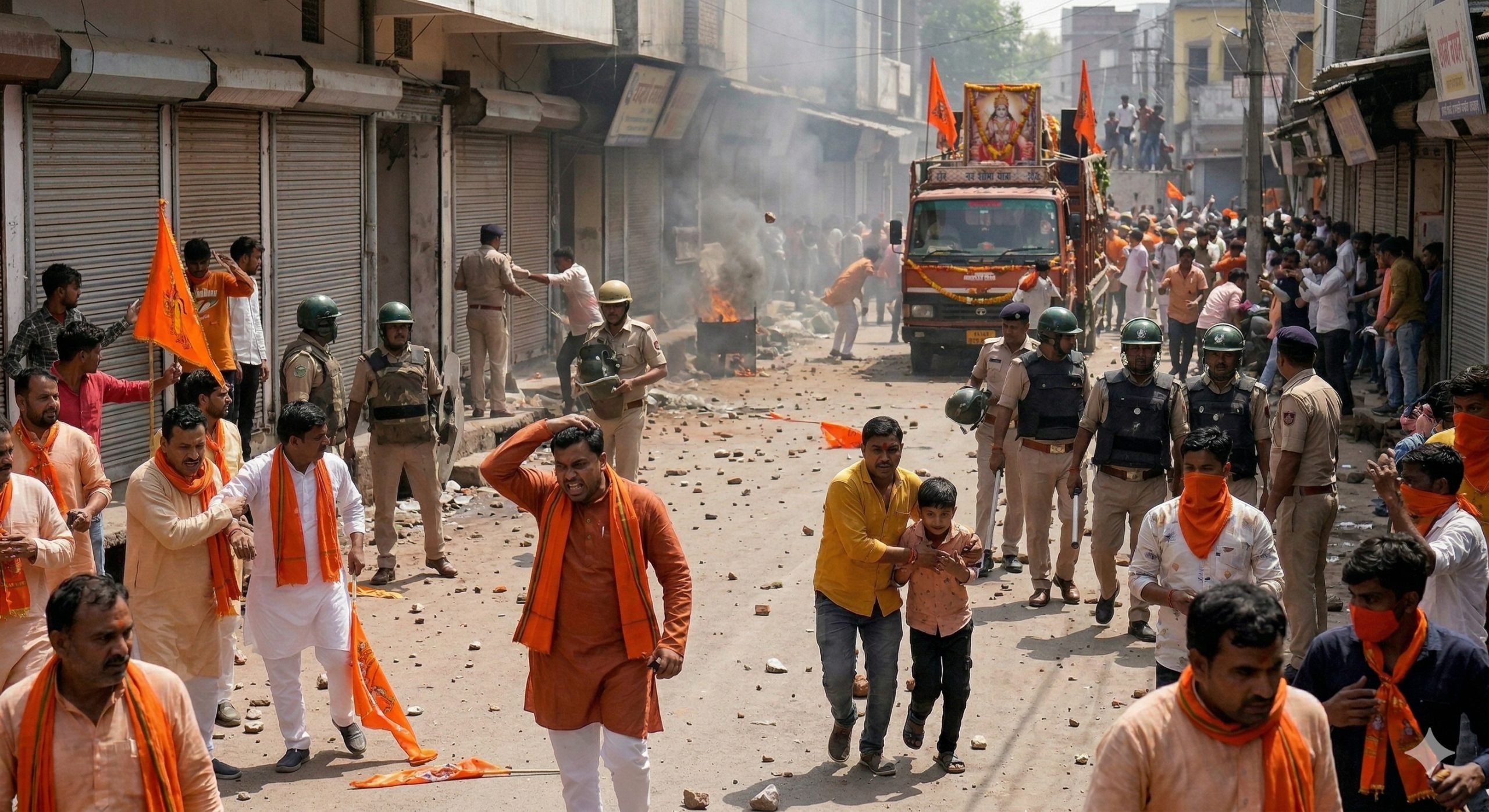
Every year on Ram Navami, as Hindus take to the streets in vibrant shobha yatras to celebrate the birth of Prabhu Shri Ram, a disturbing pattern repeats itself in various parts of the country. The processions, marked by devotion and music, are frequently met with stone-pelting, arson, and mob violence, primarily from jihadists intolerant of Hindu celebrations.
This year’s Ram Navami was no exception. Incidents across West Bengal, Jharkhand, Maharashtra, and reports from other states once again exposed how Hindu festivals are being systematically targeted. This raises serious questions: Are these truly spontaneous altercations, or pre-planned attacks designed to intimidate and suppress Hindu public expression?
Murshidabad, West Bengal: A familiar flashpoint
In Muslim majority Murshidabad’s Raghunathganj area (under Jangipur subdivision), a large Ram Navami procession heading towards Mackenzie Park came under heavy attack. According to reports, the trouble began when the procession, accompanied by music, reached the Phultala Crossing, when suddenly a group of 150-200 people pelted stones and bricks at the devotees.
Murshidabad has become Bangladesh
See how Jihadis are attacking Ramnavami Procession,Many Hindus injured pic.twitter.com/bM14DsRzTa
— Hindutva Don (@HindutvaDon_) March 27, 2026
What started as an objection over loud music quickly turned into coordinated violence at multiple spots. Stone pelting, widespread vandalism, looting, and arson of several shops and vehicles was reported.
Police responded with lathi-charge, deployed Rapid Action Force (RAF) and Central Armed Police Forces. Section 144 was imposed, a search operation was launched, and at least 12 people were arrested.
Garhwa, Jharkhand: Opposition to flags and route leads to attack on devotees
In Garhwa district’s Ramkanda block (near Kauakhoh Shiv Chabutra), tensions built on Ram Navami when some jihadists objected to the installation of a Mahavir (Hanuman) flag and the playing of music during the Ram Navami procession. After a peace committee meeting failed to fully calm the situation, the Ram Navami procession faced direct confrontation. A large group blocked the route, leading to heavy stone-pelting on the devotees and even on police personnel. Several civilians and policemen were injured. Shops in the market area downed shutters amid the chaos.
A similar incident was also reported in Dhanbad, where jihadists resorted to stone pelting on a Ram Navami procession.
Shrirampur, Maharashtra: Stones pelted from mosque
In Shrirampur town of Ahilyanagar district, a grand Ram Navami procession starting from the Gondhwani area and proceeding towards the Shri Ram Mandir came under sudden attack. As the yatra passed near Sayyad Baba Chowk mosque, stones and bricks were pelted from the mosque.
Shrirampur, Ahilyanagar: The Ram Navami procession took a violent turn when stones were pelted from a mosque. One Rambhakt was seriously injured and has lost vision in one eye.@NagarPolice pic.twitter.com/TDYaQBIsJg
— Sakal Hindu Samaj (@sakal_hindu_) March 26, 2026
Devotees were caught off guard. Several were injured, with one devotee suffering a serious eye injury and losing vision in one eye. Reports describe the attack as targeted, with Hindus filing complaints against the perpetrators. Police registered an FIR against the mosque’s Maulana and 12 others under relevant sections of the Bharatiya Nyaya Sanhita. Tension rose sharply, leading to protests by devotees demanding strict action. Barricades were erected, and police maintained heavy presence to prevent further escalation.
Stone-pelting incidents were also reported from parts of Bihar, Rajasthan, and Maharashtra.
Same script every year
This is not an isolated 2026 phenomenon. For years, Ram Navami processions have faced similar disruptions across the country.
Common elements include:
- Objections to traditional routes, devotional music, holy symbols or saffron flags — often used as pretexts.
- Coordinated stone-pelting, sometimes from elevated positions like rooftops or mosques.
- Quick escalation into arson, vandalism, and targeting of Hindu devotees.
While some mainstream narratives describe these as “clashes between two groups” triggered by minor disputes, ground reports and victim accounts consistently highlight one-sided initiation — jihadist mobs ready with stones confronting unarmed devotional processions. The assertion of Hindu identity in public spaces appears to be treated as “provocation” by radical elements, who view any visible Hindu celebration as a challenge.