-
Former PM Sher Bahadur Deuba takes a stance contrary to his party’s policy
-
Hindu organisations welcome Deuba’s stance
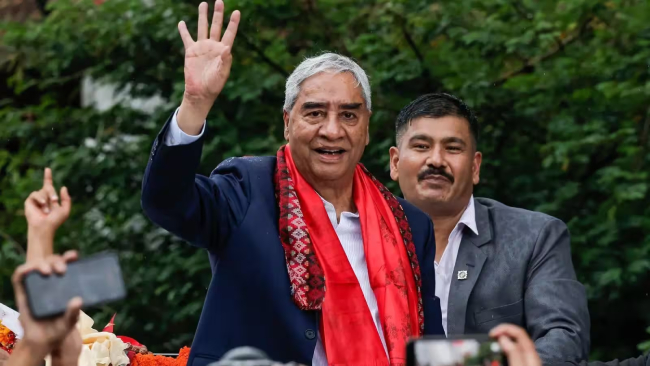
Kathmandu, Nepal – Politics in Nepal has been stirred following the statement “Ma Hindu Ho” (“I am a Hindu”) by senior Nepali Congress leader and former Prime Minister Sher Bahadur Deuba, who had once advocated that Nepal is a country that upholds religious freedom. Activists of Hindu organisations are enthusiastic over the former Prime Minister’s changed stance.
Deuba has taken a stand on linking Nepal’s national identity with Sanatan Dharma. A resolution to move in this direction was passed during the 14th National Convention of the Nepali Congress faction led by him. Consequently, discussions have begun that the demand to make Nepal a Hindu Rashtra once again is gaining political momentum.
Kathmandu: Ex-PM Sher Bahadur Deuba says “I am a Hindu” & advocates Sanatan Dharma as Nepal’s national identity.
Says people must decide if Nepal should be Hindu Rashtra.
Hindu orgs welcome move. Shift from secular stance of Nepali Congress. #Nepal #HinduRashtra pic.twitter.com/7yldQVgSsy— Pandurang Dhond (@PandurangDhond7) August 21, 2026
- The resolution passed at the convention of the Nepali Congress faction is not limited to Hindu Dharma alone. It emphasises the protection of Sanatan Dharma along with Buddhist and Kirat traditions. Furthermore, it calls for preserving religious freedom, tolerance, and social harmony among all religions and communities.
- With Deuba taking a stance divergent from that of the Nepali Congress, there is speculation about a potential split within the party. Following the general elections in Nepal, the former Prime Minister had been abroad for five months.
- Sher Bahadur Deuba said, “I am a Hindu. It is my right to speak about the religion I practice. I must have the freedom to practice Hindu Dharma. Whether to make Nepal a Hindu Rashtra or not is for the people of Nepal to decide.”
- Deuba did not directly support the demand for a Hindu Rashtra; however, by clearly articulating his Hindu identity, he has become the focal point of discussion.
- Following the former Prime Minister’s changed stance, Vishwa Hindu Parishad Lumbini Provincial President Tribhuvan Mishra, Vishwa Hindu Parishad Rupandehi President Khem Bhushal, Hindu Swayamsevak Sangh Rupandehi President Gokul Pokharel, and Hindu Dharma Samrakshan Samiti National President Anand Prasad Gupta stated that the former Prime Minister’s statement is welcome. All organisations will work together to run a broad campaign to declare Nepal a Hindu Rashtra.
- Member of Parliament from Nepal’s Kapilvastu constituency, Abhishek Shah, said that it took Sher Bahadur Deuba a long time to realise that he is a Hindu. He clarified that he has been demanding the declaration of Nepal as a Hindu Rashtra for a very long time.
Demand for Hindu Rashtra intensifies in Nepal after recent communal riots
August 9, 2026
Protests grow and hunger strike continues as Hindu organisations demand restoration of Hindu Rashtra

Kathmandu, Nepal – Following severe communal violence triggered by an attack on a Kanwar Yatra (A Hindu religious procession), momentum is rapidly building across Nepal to re-declare the nation a Hindu Rashtra. What initially began as a movement in the northern hilly regions has now spread forcefully into the Madhesh and Terai districts bordering India. In response to the escalating unrest and cross-border sensitivity, security and surveillance have been heightened along the international border in Bihar and Uttar Pradesh.
Violence triggers unrest across multiple provinces

The crisis began on 26 July in Devanganj, Sunasari district (Koshi Province), near the Indian border, when Muslims objected to the playing of a ‘DJ’ (a loud music system) during a Hindu Kanwar Yatra. The ensuing clash quickly deteriorated into widespread rioting that spread into Madhesh Province, affecting the districts of Siraha, Dhanusha, Parsa, Saptari, and Birgunj.
To bring the spiralling violence under control, police opened fire, resulting in the deaths of three Hindus, including Omprakash Mehta and 15-year-old Ganesh Yadav. The deaths sparked further outrage, causing Hindu demonstrators to retaliate and force Muslim residents to flee the area, alongside social media reports of attacks on local mosques.
HINDURASHTRA NEPAL 🚩🚩🚩❤️#Nepal is fighting back. Citizens are destroying mosques. 🔥🔥
“Miya chor Desh chhor’ slogans were raised after the brutal killing of Hindus by radical Muslims in Nepal. 🔥🔥 pic.twitter.com/tH1ZWHl4N7
— SKB (@sanatana_simha) August 5, 2026
Seeing the situation worsen, the Nepalese administration imposed an indefinite curfew across the affected regions and placed the Nepal Police, Armed Police Force, and the Nepal Army on high alert. High-security measures, military flag marches, and helicopter surveillance were deployed in commercially sensitive border towns, including Janakpurdham, Golbazar, Lahan, Birgunj, Rajbiraj, and Bode Bharsoin. Public transport along the border has been completely disrupted.
Prime Minister Balen Shah addressed the nation to appeal for calm and religious harmony while ordering a high-level committee to conduct an impartial investigation. However, the administration has faced fierce backlash from human rights groups and former Prime Minister Pushpa Kamal Dahal, who accused the government of failing to take timely political steps to prevent the violence from spreading across six major cities. Meanwhile, the Dewanganj Rural Municipality locally declared the deceased as ‘martyrs’ and demanded official recognition alongside 10 lakh Nepalese rupees in financial relief for each family.
Demographic shifts and growing discontent
The surge in public anger stems from long-standing concerns among Nepali Hindus regarding rapid demographic changes. Over recent years, the Muslim population in Nepal has grown significantly—initially in the southern border districts of Terai and Madhesh, and more recently extending into the central and northern hill regions. Allegations of religious conversions have further fuelled resentment among the local population, with videos of local protests widely shared online.
High-level talks and unification of Hindu organisations

In the wake of the riots, Nepal’s Home Minister Sudan Gurung visited the affected border zones to meet with local residents and victim families. During his visit, a meeting with the ‘Hindu Samrat Sena’ drew widespread media attention. According to Nepali media reports, the minister discussed a 13-point proposal that included opening formal dialogue on restoring Nepal’s status as a Hindu Rashtra.
Although officials later clarified to the Nepalese news channel Kantipur that the meeting was merely a forum for the group to present its demands rather than a formal agreement, a submitted memorandum by the ‘Samyukta Hindu Morcha’ surfaced on 2 August. The memorandum demands that the government convene an all-party meeting within three months to establish a clear timeline for re-establishing a Hindu Rashtra.
🚨BIG NEWS – Nepal’s government has signed a 19-point agreement with the Hindu Samrat Sena Nepal, promising all-party and parliamentary discussions within 3 months on the demand to restore Nepal as a
Hindu Rashtra 🔱🕉️
A significant moment in Nepal’s… pic.twitter.com/m0UiwF8Cc0
— Sheetal Chopra 🇮🇳 (@SheetalPronamo) August 5, 2026
Despite government efforts to restore calm, public opposition continues to rise. Over 15 Hindutva organisations and political parties, including the Samyukta Hindu Morcha, Hindu Samrat Sena, Rastriya Prajatantra Party, and Hindu Yuva Sangh, have united on a single platform. Through joint strategy sessions and public outreach, leaders affirm that the demand for a Hindu Rashtra is no longer a regional issue, but a national imperative.
Activist Vinay Yadav’s indefinite hunger strike

Adding to the pressure on the government, prominent political and social activist Vinay Yadav has been on an indefinite hunger strike for the past 10 days at Maitighar Mandala in Kathmandu. Yadav, who serves as the President of the ‘Rastriya Ekta Dal’ and Chief Co-ordinator of the civil platform ‘Rastriya Ekta Abhiyaan’, declared that he will not break his fast until the government fulfills its promises and accepts key demands.
His primary demands include:
- Securing justice for the Hindu victims of the Sunasari violence and fully implementing the government’s settlement terms.
- Fulfilling assurances to grant ‘martyr’ status to the three deceased Hindus, providing 10 lakh Nepalese rupees and a government job to each family, offering free medical treatment for the injured, and carrying out an impartial inquiry.
- Formally re-declaring Nepal a ‘Hindu Rashtra’.
- Ending reservations for Muslims and dissolving the Muslim Commission.
- Taking strict action against illegal infiltration and perpetrators of anti-Hindu violence.
🇳🇵 Nepal Activist’s Hunger Strike Enters Day 10!
Social activist & Rashtriya Ekta Dal President Vinay Yadav is on an indefinite fast at Maitighar Mandala, Kathmandu, demanding Hindu Rashtra and other demands
📌 Key Demands:
🔹 Declare Nepal a ‘Hindu Nation’ again 🕉️🔹… https://t.co/5Ch3Sz2f4o pic.twitter.com/yNbB5l5n06
— Sanatan Prabhat (@SanatanPrabhat) August 8, 2026
Yadav has a long history of high-profile civil agitations in Nepal, having previously led demonstrations against corruption at Pokhara Airport, campaigned against China’s territorial encroachments and its ‘Belt and Road Initiative’ (BRI), opposed the Madhesh Provincial Government’s Madrasa Bill, and protested against broadcast programmes involving Christian missionaries.