At the convergence of the Kadamba bypass in Old Goa stands a tall, slender column with a dark history. Locally, it is known as the ‘Haat Katro Khamb’, meaning the pillar where hands were chopped off.
It is a relic of an ancient temple, and going by some portions, it appears to be from the Kadamba era, circa the 12th – 13th century AD. The Portuguese razed several temples and used the relics of these temples, such as the pillars, capitals, doorframes, and windows, to decorate their own structures in the 16th and 17th centuries.
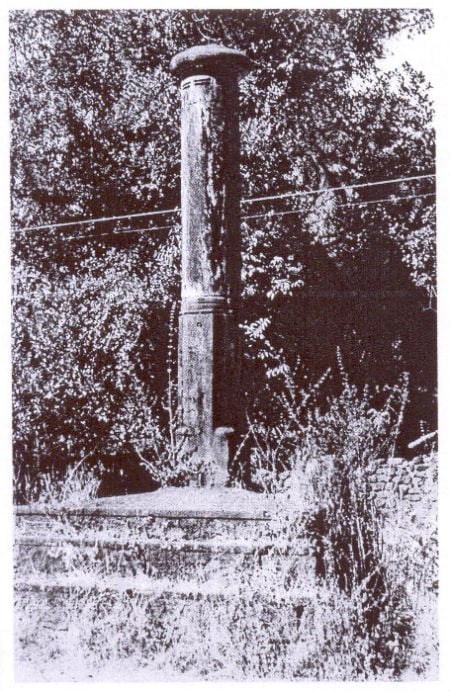
The Inquisition was the darkest and the most brutal period in the history of colonial Goa. It was introduced in October 1560 at Old Goa. The Haat Katro Khamb today stands as a symbol of the persecution inflicted by the Portuguese ecclesiastical authorities on the Hindus.
On the Haat Katro Khamb of Old Goa, there is a short Hale Kannada inscription, which must be from the ancient temple from the Kadamba era.
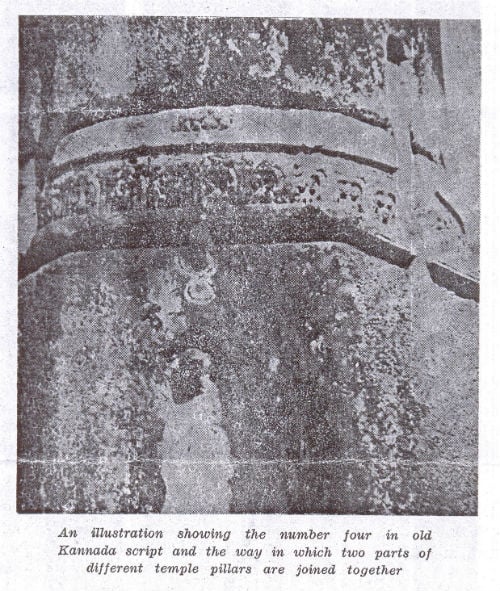
The inscription, which reads as ‘DAYADNYA’ along with the number four in Kannada, was discovered by Dr. P. P. Shirodkar, Director of Archives, Archaeology and Museums, when he had gone over there to look for any vestiges of the Goa Inquisition.
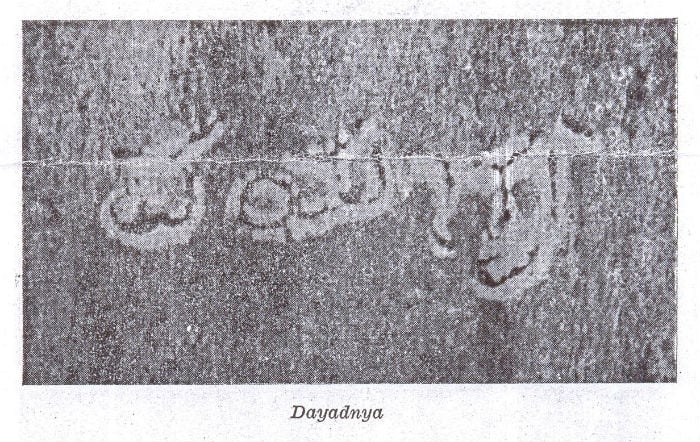 The inscription remained undetected for centuries, probably on account of the fear traditionally associated with this monument of the Inquisition. The New Pillory, commonly called the ‘Haat Katro Khamb’ by the local people, had been constructed by the end of the 16th century when the Old Pillory, which stood close to the rotunda of the statue of Mahatma Gandhi, was abandoned. These pillories served as devices for publicly punishing offenders of the law who, on being tied to them, were whipped. At times, these devices were used to disjoint the hands by twisting the cords so tightly that the victims permanently lost the use of their upper limbs. That is the reason why the local people have continued to call it the ‘Haat Katro Khamb’. It lies at the foot of the mount of the Cross of Miracles, on the way to Neura.
During the last century, as illustrated by Sr. Lopes Mendes in his book A India Portugueza, it had seven laterite steps for the victims to climb up, and it served as a platform for the pillory. However, in more recent times, it has been repaired, and since it is in disuse, no steps have been provided except for an approximately 3½ ft. partly plastered platform of laterite.
The Pillory, which was formed of two different parts of the pillars of the old temple, was joined together by iron rings to keep it erect. The upper portion with the capital at the top is round in shape, and the lower portion is SRIDHARA, i.e., an octagonal pillar with a square base. It has a roundish ornamental sculpture above it, which had served as a base for fixing the upper pillar. The inscription is at the foot of the pillar, and the number four is just below the ornamental round part above.
The existence of the inscription gives credence to the belief that the two parts of the pillory were originally the pillars of the old temple, and most probably of the old Shiva temple of Saptanath in the Malar area of Divar, the stones of which had been used under instructions from the Portuguese authorities for the construction of the churches and convents at Old Goa. The Saptanath temple had been erected by Madhav Mantri, a Minister of the Vijayanagara Kingdom in 1391 A.D., which was subsequently destroyed during the period of Bahamani rule in 1471 and later on by the Portuguese. In 1515, Fr. Andre Corsali, a resident from Florence, while writing from India, had described it as one of the best temples he had ever seen and that its sculpture and architecture far surpassed that of European stone ornamentation.
 The word ‘DAYADNYA’ on the pillar may be a reference to Bhagwan Shiva, who is considered as ‘one who shows mercy’. The number four probably refers to the four sects of Shaivism, namely Kapalic, Kalamukh, Pashupat, and Shaiva. This leads one to believe that it might have been a part of the pillar of a Shiva temple, which could only be of one in the vicinity of Old Goa, i.e., Saptanath of Divar. Incidentally, it can be pointed out that the exquisitely carved pillar, probably a Deepstambh of the same temple, still stands inside the compound of the Museum of the Archaeological Survey of India at Old Goa, and its upper portion, with an arrangement for wicks and oil, has been used as a Baptismal Font at the door of the Church of St. Francis of Assisi.
The discovery of the new inscription throws new light on the pillar architecture of ancient Goa.