Content
A devoted soldier of Dharma
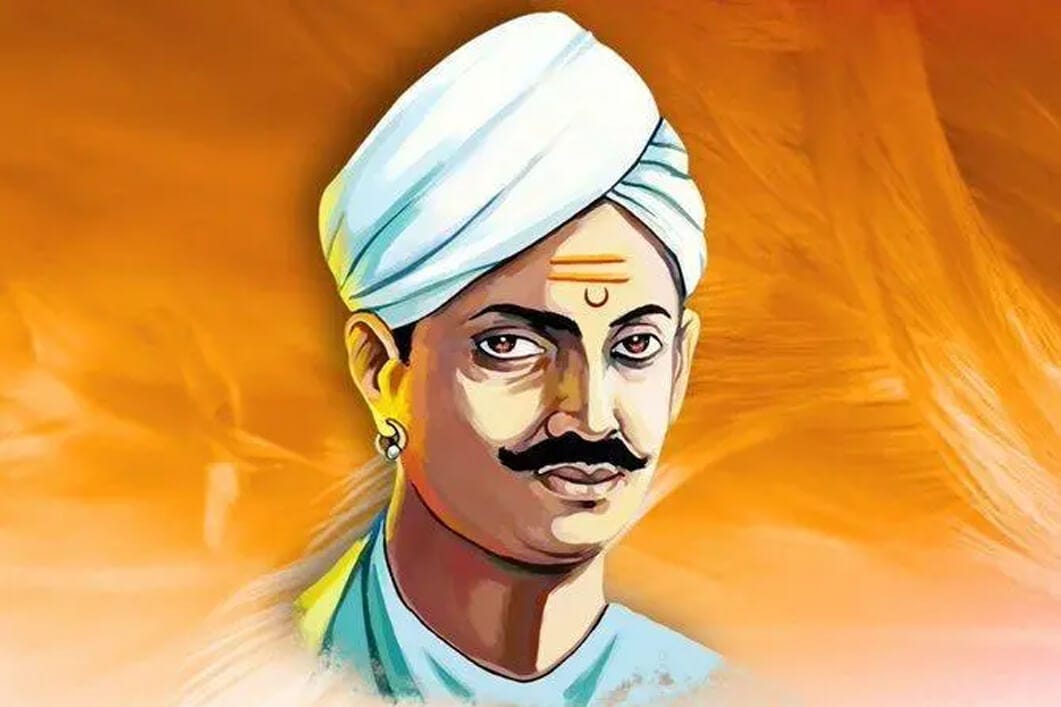
Mangal Pandey was a young sepoy serving in the 34th Bengal Native Infantry. Deeply committed to his fellow soldiers and his sense of duty, he became part of the growing unrest against British policies that disregarded Indian religious sentiments.
The British had introduced new Enfield rifle cartridges coated with cow and pig fat. To load the rifle, soldiers had to bite off the paper casing, which would bring the fat into contact with their mouth. This deeply offended the religious beliefs of the sepoys. When the 19th battalion was ordered to test these cartridges at Barrackpore near Kolkata, the soldiers refused.
The shrewd British officers did not react that day as they were outnumbered, and planned to call in for reinforcements from Burma (Mynamar). They planned to disarm the Indian soldiers, humiliate them publicly, and disband the regiment. Mangal Pandey was deeply angered by the thought of his brethren facing such humiliation. He was a man who valued his dharma more than his own life. With a strong sense of purpose, he felt a powerful call to defend the honour of his comrades.
The leap into the parade ground
Shrimant Nanasaheb Peshwa had prepared a plan for a widespread uprising against the British on 31st May. Yet Mangal Pandey could not remain silent in the face of the impending humiliation facing his brethren. On Sunday, 29th March 1857, he loaded his gun and stepped forward onto the parade ground of the 34th Bengal Native Infantry.
There, he called upon the Indian soldiers to rise against the injustice. With conviction, he urged them: “Brothers, do not hesitate! Attack now! Remember your pledge to Dharma. Come, let us destroy the enemy and win our freedom!”
Sergeant Major Hudson ordered the soldiers to seize him, but no one moved. Mangal Pandey fired and struck Hudson. Lieutenant Baugh, the adjutant, then rushed towards him on horseback. Pandey took aim and fired; his bullet missed Baugh but struck the horse, bringing both rider and mount crashing to the ground. Before Pandey could reload, Baugh fired his pistol at him. Undeterred, Pandey drew his sword, dodged the bullet, and charged towards Baugh. He wounded Baugh with his sword. Hudson, who had also been injured earlier, joined the clash but was overpowered as well. The two British officers then retreated to safety.
The traitor Shaikh Paltu
Soon after, a Muslim sepoy named Shaikh Paltu from the same battalion approached Mangal Pandey. Pandey believed he had come to support him, but Paltu grabbed him from behind. Pandey broke free as other Indian soldiers began pelting Shaikh Paltu with stones and boots. The traitor Paltu fled to save himself.
Colonel Wheeler arrived shortly and ordered the soldiers to arrest Pandey. They refused, stating they would not lay hands on a man standing for Dharma. Observing the mood of the soldiers, the Colonel withdrew.
Later, General Hearsey reached the spot with European troops. By then it was noon, and Mangal Pandey, exhausted, realised he would soon be captured. He turned his gun towards his own chest and fired, collapsing unconscious. Only then could the British take him into custody. The injured sepoy was taken to the military hospital.
Sacrifice and lasting impact
Within a week, Mangal Pandey was tried by a military court. He refused to reveal the names of any others involved, placing his dharma and loyalty above all else. He was sentenced to death. His courage stirred such strong respect that no one in Barrackpore was willing to act as hangman for his execution. Four men had to be brought from Kolkata to carry out the sentence.
On 8th April 1857, Mangal Pandey was led to the gallows under heavy guard. He climbed the scaffold with composure and once more declared that he would disclose no names. As the platform dropped, he became the first martyr of the 1857 war of independence. His bravery left such an impression that the British started referring to the Indian soldiers in this struggle as “Pandeys”.
The 34th Bengal Native Infantry was later disarmed and disbanded with disgrace on 6 May 1857. This harsh punishment only strengthened the resolve of the soldiers. Hundreds of soldiers tore off their uniforms — symbols of subjugation — and took a holy dip in the Ganges, seeking purification from the sin of serving the British..
Mangal Pandey’s sacrifice inspired countless patriots and lit the spark that grew into the wider movement for freedom.
Inspiring lines dedicated to the Martyrs of 1857 written by Swatantryaveer Savarkar
This is a dedication to the Martyrs of 1857 which was written by Savarkar on the occasion of the 51st anniversary of the Indian War of Independence 1857. It was then published under the title ‘Oh Martyrs’ and circulated on the 10 May 1908 at the time of the Golden Jubilee ceremony which was celebrated in England on a grand scale.
Oh Martyrs!
“The battle of freedom once begun
And handed down from sire to son
Though often lost is ever won!!”
Today is the tenth of May! It was on this day, that in the ever memorable year of 1857, the first campaign of the War of Independence was opened by you, Oh Martyrs, on the battle-field of India.
The Motherland, awakened to the sense of her degrading slavery, unsheathed her sword, burst forth from the shackles and struck the first blow for her liberty and for her honour.
It was on this day that the war-cry ‘Maro Feringhee Ko’ was raised by the throats of thousands. It was on this day that the sepoys of Meerut, having risen in a terrible uprising, marched down to Delhi, saw the waters of the Jamuna, glittering in the sunshine, caught one of those historical moments which close past epoch to introduce a new one, and converted the mutiny into a national and a religious war.
All honour be to you, oh Martyrs. For it was for the preservation of the honour of the race that you performed the fiery ordeal of a revolution when the religions of the land were threatened with a forcible and sinister conversion, when the hypocrite threw off his friendly garb and stood up into the naked heinousness of a perfidious foe breaking treaties, smashing crowns, forging chains and mocking all the while our merciful mother for the very honesty with which she believed the pretensions of the white liar. Then you, oh Martyrs of 1857, awoke the mother, inspired the mother, and for the honour of the mother, rushed to the battlefield terrible and tremendous with the war-cry ‘Maro Feringhee Ko’ on your lips, and with the sacred mantra God and Hindusthan on your banner!
Well did you do in rising. For otherwise, although your blood might have been spared, yet the stigma of servility would have been the deeper, one more link would have been added to the cursed chain of demoralizing patience, and the world would have again contemptuously pointed to our nation saying, ‘She deserves slavery, she is happy in slavery.’ For even in 1857, she did not raise even a finger to protect her interest and her honour!
This day, therefore, we dedicate, oh Martyrs, to your inspiring memory! It was on this day that you raised a new flag to be upheld, you uttered a mission to be fulfilled, you saw a vision to be realized, you proclaimed a nation to be born!
We take up your cry, we revere your flag, we are determined to continue that fiery mission of ‘away with the foreigner’, which you uttered, amidst the prophetic thunderings of the Revolutionary war.
Revolutionary, yes, it was a Revolutionary war. For the War of 1857 shall not cease till the revolution arrives, striking slavery into dust, elevating liberty to the throne.
Whenever a people arises for its freedom, whenever that seed of liberty gets germinated in the blood of its fathers, whenever that seed of liberty gets germinated in the blood of its Martyrs, and whenever there remains at least one true son to avenge that blood of his fathers, there never can be an end to such a war as this. No, a revolutionary war knows no truce, save liberty or death.
We, inspired by your memory, determine to continue the struggle you began in 1857, we refuse to acknowledge the armistice as a truce; we look upon the battles you fought as the battles of the first campaign—the defeat of which cannot be the defeat of the war.
VANDE MATARAM