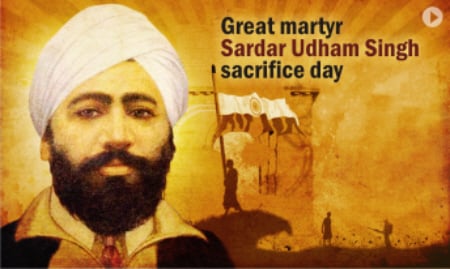
July 31 marks the martyrdom day of Sardar Udham Singh, fondly remembered across India as the Tiger of Punjab. On this day, the nation pays homage to his enduring courage and supreme sacrifice.
A Sworn Enemy of British Empire
On June 5, 1940, at the Old Bailey Court in London, Justice Atkinson prepared to deliver his sentence. Before him stood a resolute Indian man in his early 40s, holding his head high. Granted a final opportunity to address the court, Udham Singh spoke for twenty minutes:
“I have seen many children dying of malnutrition in India under British rule. I have witnessed with my own eyes the massacre committed by General Dyer under the orders and approval of O’Dwyer. These events made me a sworn enemy of the British Empire. Had I not assassinated O’Dwyer in revenge, it would have been a stain on Hindustan’s honor. I am not bothered by a 10, 15, or 20-year prison term, or even the death sentence. What purpose does it serve to live into old age? True glory lies in dying young. I wish to die a martyr for my nation!”
Outraged by this scathing indictment of British colonial exploitation, the judge forgot to don the traditional black cap while reading the death penalty until an alert orderly placed it on his head. Disturbed by the impact of his words, the court imposed a gag order, banning the speech from public publication.
The Vow at Jallianwala Bagh
Born on December 28, 1899, in Sunam in the princely state of Patiala, Udham Singh was serving water as a volunteer to the assembly gathered at Jallianwala Bagh, Amritsar, on April 13, 1919.
When troops under General Dyer opened fire on the trapped crowd, Udham Singh was hit by a bullet and fell. Despite his injuries, he dragged himself up amidst the carnage to tend to the wounded. The tragic incident left hundreds dead—379 according to official colonial estimates, and over 1,000 according to national assessments—and more than 1,200 injured. The brutal action was endorsed by the Lieutenant Governor of Punjab, Sir Michael O’Dwyer. From that bloody afternoon onward, Udham Singh dedicated his life to seeking justice for his countrymen.
Justice Served After 21 Years
Udham Singh later aligned with Bhagat Singh and the Hindustan Socialist Republican Association (HSRA). In 1927, he was arrested in India for possessing unlicensed firearms and spent five years in prison. Following his release, he traveled to England in 1933 under various aliases, determined to carry out his vow.
While in England, Udham Singh took on various jobs—working as a carpenter, motor mechanic, and chauffeur—to seamlessly navigate different social circles. Over several years, he deliberately cultivated a social acquaintance with Michael O’Dwyer, even taking up employment opportunities that brought him into O’Dwyer’s vicinity to closely monitor his daily routine and movements. This built enough rapport that, by early 1940, O’Dwyer invited him to his Devonshire residence for tea. Udham Singh accepted the invitation, but chose not to strike in private, preferring to execute his plan in a public forum to maximize the political impact across the British Empire.
On March 13, 1940, at a meeting hosted by the East India Association and the Royal Central Asian Society at Caxton Hall, London, O’Dwyer took the stage alongside several high-ranking British figures. As the meeting concluded, Udham Singh stepped forward from the crowd and fired six shots from his revolver at point-blank range.
Michael O’Dwyer was killed instantly by two shots. The remaining bullets wounded Lord Zetland (Secretary of State for India), Lord Lamington (former Governor of Bombay), and Sir Louis Dane (former Lieutenant Governor of Punjab). Udham Singh made no attempt to escape and surrendered on the spot.
Married to the Gallows
While held in Pentonville Prison, Udham Singh wrote to his friend Shiv Singh Johal:
“I am never afraid of death. I am going to marry the gallows soon. It has been 10 years since my dear friend Bhagat Singh left me. I shall meet him after my death; he is waiting for me.”
In prison, he underwent severe mistreatment and launched a 42-day hunger strike in protest, during which he was force-fed. When his conviction was handed down, he raised his fist and shouted the popular revolutionary slogan “Inquilab Zindabad!” three times. To demonstrate his disdain for the colonial court, he spat across the solicitor’s table before being led away.
On July 31, 1940, Sardar Udham Singh was hanged at Pentonville Prison. Personal vengeance may be satisfied in a year or two, but national retribution requires unwavering resolve. Demonstrating that an Indian patriot would wait decades to redeem his nation’s honor, Udham Singh etched his name into the annals of the Indian independence movement.