
Life without Dharma is akin to life without oxygen, that in other words is being as good as dead. Dharma is the soul of an individual. If everyone complies with the teachings of Dharma, nature will become favourable to human happiness. This article explains origin, definition and meaning of Dharma, creation of Dharma and importance of abiding by Dharma.
1. Origin, Definition and Meaning
A. Dharma is not religion
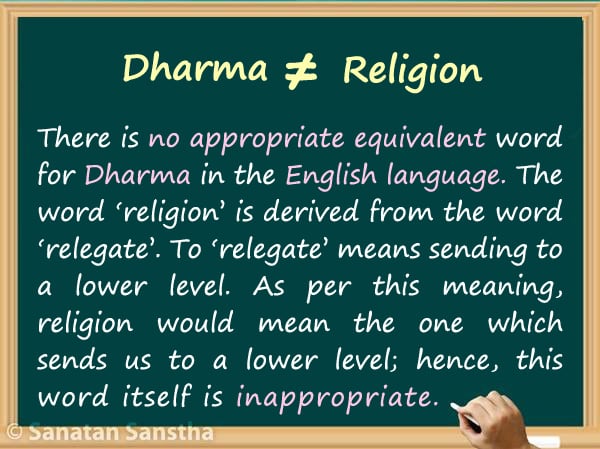
There is no appropriate equivalent word for Dharma in the English language. The word ‘religion’ is derived from the word ‘relegate’. To ‘relegate’ means sending to a lower level. As per this meaning, religion would mean the one which sends us to a lower level; hence, this word itself is inappropriate. On the contrary, Dharma is one which elevates us to a higher plane. The word ‘Dharma’ is used with different meanings in different Holy texts. In order to understand the scope of the word, some of its important origins, definitions and meanings are given here. Till we attain the state of Turyavastha, we will not understand the true meaning of Dharma. Turyavastha is the fourth state beyond the three states of wakefulness, deep sleep and dream, that is, the state of meditation.
B. In the context of society
-
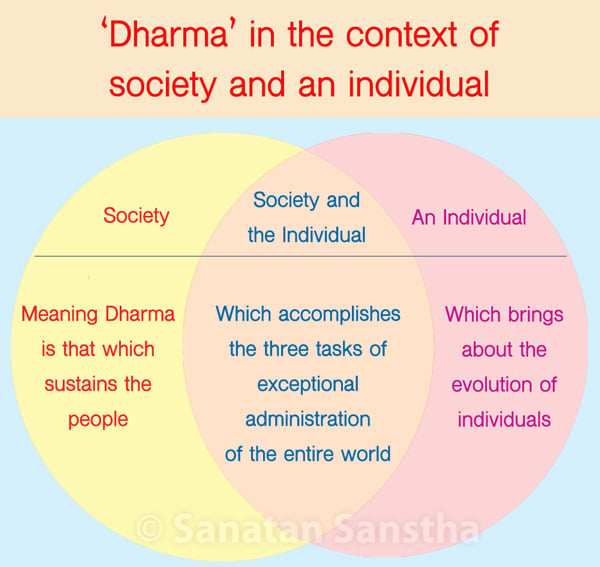
‘धृ धारयति’ means to bear, or to support. The word ‘Dharma’ (धर्म) has been derived from the root ‘dhru (धृ)’. ‘धरति लोकान् ध्रियते पुण्यात्मभिः इति वा धर्मः ।’, meaning Dharma is that which sustains the people or that which is adopted by meritorious souls.
-
धारणाद्धर्ममित्याहुः धर्मो धारयति प्रजाः । – Mahabharat, Karnaparva, Adhyaya 49, Shloka 50
Meaning : Dharma is that which nurtures the subjects and, in turn, the society.
-
धारणाद्धर्म इत्याहुः धर्मेण विधृताः प्रजाः ।
यस्माद्धारयते सर्वं त्रैलोक्यं सचराचरम् ।।
Meaning : Due to its quality of ‘dharan’ (To nurture), it acquired the term ‘Dharma’. Subjects are nurtured through Dharma. As a result, the entire universe containing the three regions is supported by Dharma.
-
धारणाद्विद्विषां चैव धर्मेणारञ्जयन्प्रजाः ।
तस्माद्धारणमित्युक्तं स धर्म इति निश्चयः ।।
Meaning : By controlling the enemy, meaning the adharma (Un-righteousness), and by adhering to the law, Dharma sustains its subjects. In this way, Dharma supports its subjects, meaning the society.
C. In the context of an individual
-
प्रभवार्थाय भूतानां धर्मप्रवचनं कृतम् ।
यः स्यात्प्रभवसंयुक्तः स धर्म इति निश्चयः ।। – Mahabharat, Shantiparva, Adhyaya 109, Shloka 10
Meaning : The sole aim with which Dharma is advocated is to bring about the evolution of individuals. A doctrine preaches, ‘that which is able to bring about evolution is Dharma.
-
When an individual performs Dharmacharan (Abiding by Dharma) during the course of his life, he evolves spiritually. He attains positive momentum even in life after death, meaning, he attains a place in superior regions such as Maharlok, Janalok and Tapolok. Dharma is a unique means of liberating man from the ignorance (illusion of Raja – Tama components) in which he is trapped with the help of the same ignorance (Sattva component in this case).
-
In the Brahmangranth (A Holy text), the meaning of the word ‘Dharma’ is Ashramdharma as is understood from the quote ‘त्रयो धर्मस्कन्धाः …’ from the Upanishads. It also means the duties allotted to, or accepted by, an individual according to the Varnashram.
D. In relation to both the society and the individual
-
जगतः स्थितिकारणं प्राणिनां साक्षात् अभ्युदयनिःश्रेयसहेतुर्यः स धर्मः । – Adi Shankaracharya (In the preface to the commentary on Shrimadbhagwadgita)
Meaning : Dharma is that which accomplishes the three tasks of exceptional administration of the entire world, bringing about the worldly progress of every living being and causing progress in the spiritual realm (attaining Moksha ) as well.
E. Difference between Dharma and adharma
-
Dharma means agraha and adharma means duragraha.
-
When does Dharma acquire the form of adharma and adharma that of Dharma?
Dharma done with a depraved mind is adharma, and adharma done for a noble cause is Dharma. Telling a lie for the sake of a cow and a monk is also Dharma.
2. Synonyms
A. Sanatan Dharma
Origin :
‘सना आतनोति इति सनातनः ।’ Sana means eternal and ‘atanoti’ means attaining. Therefore, ‘Sanatan (Sana + Atanoti)’ means that which makes you attain the eternal.
Meaning :
‘सनातनो नित्यनूतनः । ’ means that which is eternal, has no beginning and yet is always new, meaning, it never ages, is called Sanatan. Only that which repeatedly manifests in a new form will last, for example, one should expect a tree to die when no new shoots spring from it. In the Bhavarthadipika (Dnyaneshwari 1.71), Saint Dnyaneshwar has said that each time one contemplates (on the Shrimadbhagwadgita), the Principle of the Holy Shrimadbhagwadgita appears to be new. (In other words, each time, one understands a different meaning.) ‘Sa’ in the word ‘Sanatan’ is the seed of the Sun Principle which symbolises the Absolute Fire Principle.
‘San’ (सन्) from the word ‘Sanatan’ means the present and ‘atan’ (अतन) means that which has no body, meaning that which is beyond the realm of time. This itself is termed as ‘Brahman’.
B. Vedadharma or Vedic Dharma
‘Vid’ in Sanskrut means to understand. The word ‘Ved’ is derived from the verb ‘vid’. Ved means knowledge, the subject matter of knowledge or the means to acquire it. Knowledge, in this context, refers to the knowledge of the soul, the realisation of God or spiritual experiences.
3. Creation of Dharma
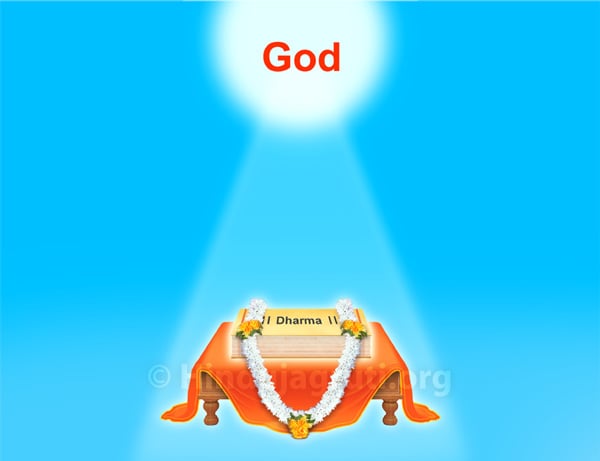
God created the universe in times immemorial. At the same time He created Dharma.
चात्रो धर्मो ह्यादिदेवात्प्रवृत्तः पश्चादन्ये शेषभूताश्च धर्माः । – Mahabharat, Shantiparva, Adhyaya 64, Shloka 20
Meaning : The original Dharma was created from Supreme God. All other sects were created later.
4. Dharma and Dharmi
A. Sweetness is the quality of sugar. That which possesses the quality of sweetness is the Dharma and its Dharmi are inseparable. They are merged into one another. The relationship between God and Dharma is akin to that between sugar and its sweetness, which are inseparable. God is the Dharmi. His quality is Dharma. A quote says ‘धर्मो नारायण स्मृतः ।’, meaning Dharma is Narayan (God). Dharma of God cannot have different identities; hence, there is only one Dharma and that is the Sanatan Dharma. For this reason, history of Dharma is effectively the history of the search for God.
B. Dharma is deduced from the Scriptures; but God and Brahman are those who illuminate the Scriptures.
5. Importance
A. Just as there is no life without respiration, so also life without Dharma is not a worthy life, as it amounts to an existence like animals.
B. Dharma is not for developing intelligence; it is for developing character.
C. आगमानां हि सर्वेषाम् आचारः श्रेष्ठ उच्यते ।
आचारप्रभवो धर्मो धर्मादायुर्विवर्धते ।। – Mahabharat, Anushasanparva, Adhyaya 107, Shloka 147
Meaning : When compared with all knowledge, good conduct is considered to be superior; because Dharma is based on achars (Conduct). When man abides by achardharma, his life is prolonged.
D. धर्मादर्थः प्रभवति धर्मात्प्रभवते सुखम् ।
धर्मेण लभते सर्वं धर्मसारमिदं जगत् ।। – Valmikiramayan, Aranyakanda, Sarga 8, Shloka 26
Meaning : Dharma bestows wealth as well as happiness. In fact, everything can be acquired through Dharma. This entire universe sustains itself on the foundation of Dharma.
E. ऊर्ध्वबाहुर्विरौम्येष न च कश्चिच्छृणोति मे ।
धर्मादर्थश्च कामश्च स किमर्थं न सेव्यते ।। – Mahabharat, Swargarohanparva, Adhyaya 5, Shloka 46
Meaning : (Sage Vyas says) With my arms raised, I am lamenting, yet no one listens to me. (O human beings) Dharma accomplishes both, earning of wealth and fulfilling of desires. Then, why do you not abide by Dharma ?
F. सुखार्थाः सर्वभूतानां मताः सर्वाः प्रवृत्तयः ।
सुखं च न विना धर्मात् तस्माद्धर्मपरो भवेत् ।। – Vagbhat (Ashtangarhudaya, Sutrasthan, Adhyaya 2, Shloka 19)
Meaning : All the actions of living beings are for attaining happiness. (Even the motive in unrighteous conduct is attaining happiness). However, there is no happiness without Dharma; hence, abide by Dharma always.
G. धर्म एव हतो हन्ति धर्मो रक्षति रक्षितः । – Mahabharat, Vanaparva, Adhyaya 314, Shloka 128
Meaning : Those who do not follow Dharma are destroyed, and those following it meticulously are protected by Dharma (that is, God).
H. स्वल्पमप्यस्य धर्मस्य त्रायते महतो भयात् । – Shrimadbhagwadgita Adhyaya 2, Shloka 40
Meaning : Even if Dharma is followed to a small extent, it protects from larger danger.
I. धर्मेणैव जगत्सुरक्षितमिदं धर्मो धराधारकः ।
धर्माद्वस्तु न किञ्चिदस्ति भुवने धर्माय तस्मै नमः ।।
Meaning : The world remains safe if everyone abides by Dharma; that is why Dharma is said to be the main supporter of earth. There is nothing more ethical than Dharma in this world. Hence, I pay obeisance to that Dharma.
J. अधर्म एव मूलं सर्वरोगाणाम् ।
Meaning : Unrighteousness is the root cause of all diseases. There are three categories of diseases, namely Adhibhoutik, Adhidaivik and Adhytmik. Adhibhoutik diseases arise from physical causes such as earthquake, famine etc. Adhidaivik diseases occur due to malefic planets, curses of Saints and Sages and wrath of Deities etc.
Adhyatmik diseases are distress due to negative energies such as ghosts, destiny etc. (According one school of thought, the aforementioned Adhyatmik distress is also included under Adhidaivik distress. Adhyatmik distress means physical and psychological distress occurring due to imbalance of bodily humours namely vata [Air], pitta [Bile] and kapha [Phlegm].)
K. धर्म एको मनुष्याणां सहायः पारलौकिकः । – Mahabharat, Anushasanparva, Adhyaya 111, Shloka 17
Meaning : Dharma alone is the companion of man in other worlds, that is, in life after death.
L. यतो धर्मस्ततो जयः । – Mahabharat, Udyogparva, Adhyaya 39, Shloka 7
Meaning : Wherever there is Dharma, there is victory.
M. Due to not following Hindu Dharma calamities like cyclones, earthquakes, excessive rainfall, droughts, internal conflicts, attacks by foreign countries have become common everywhere.
N. If everyone complies with the teachings of Dharma, nature will become favourable to human happiness. Saint Dnyaneshwar has said precisely the same thing in one of His works, that one gets results as per one’s desires and that is applicable not merely to human beings, but to the entire animal kingdom and immovable nature; for, depending on our karma, we can even get the birth of an unmoving living being. Only when human beings progress will the moving and unmoving components of nature become happy, and should they fail to progress, then they will have to face the demerit of making this all – encompassing environment unhappy.
Reference : Sanatan Sanstha’s Holy text ‘Abiding by and protection of Dharma‘ and ‘Fundamental analysis of Dharma‘
only dharma saves the universe