At just 18, he sacrificed his life for the Motherland
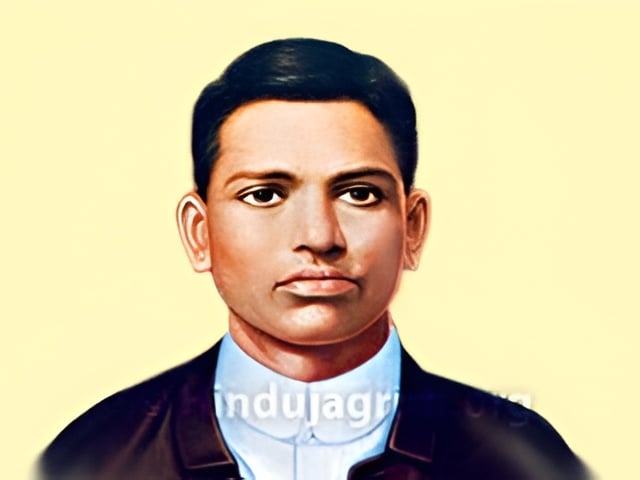
On 19 April 1910, the young patriot Anant Laxman Kanhere attained martyrdom on the gallows at the tender age of 18. He laid down his life for the sacred cause of Bharat’s freedom. Let us remember this courageous son of Bharat with deep reverence and gratitude on the anniversary of his supreme sacrifice.
Birth and early life
Anant Laxman Kanhere (often called Anantrao) was born in 1892 into a Chitpavan Brahmin family in the village of Aayani-Mete, located near Khed in Maharashtra’s Ratnagiri district. One of his ancestors had fought valiantly and laid down his life in the historic Battle of Panipat, a legacy of bravery that perhaps inspired the young Anant.
As a bright and determined young man, Anant moved to Aurangabad (present-day Chhatrapati Sambhajinagar) for his English education, staying with his maternal uncle. It was here, in the vibrant atmosphere of growing nationalist sentiment, that Anant came into contact with revolutionary ideas.
Test of courage and induction into Abhinav Bharat
Anant lived with his friend Gangaram Marwadi, who had already taken the oath of the secret revolutionary society Abhinav Bharat, founded by the Savarkar brothers. Before inducting him, Gangaram put Anant to a severe test of endurance and determination. He heated the glass chimney of a lamp until it was red-hot and asked Anant to hold it firmly with both hands. Despite suffering painful burns, Anant remained completely steady and did not flinch even once. Impressed by his iron resolve, Gangaram administered the oath of patriotism, and Anant formally joined the ranks of Abhinav Bharat.
Inspired by the ideals of Swaraj and the revolutionary spirit of leaders like Veer Savarkar, Anant resolved to fight British tyranny with courage and sacrifice.
Collector Jackson: The hypocritical and vindictive face of British rule
At that time, Nashik district was under the charge of a District Collector named Arthur Mason Tippetts Jackson, whose conduct deeply angered the revolutionaries. Jackson tried his utmost to instil fear of the British among the people and to suppress any efforts towards independence. He learnt Sanskrit and Marathi for this purpose and would often claim that in his previous birth he had been a learned Brahmin well-versed in the Vedas. To the revolutionaries, this appeared to be merely a clever trick to deceive innocent and simple-hearted people.
There was one British officer named William who had kicked an innocent farmer to death, yet Jackson tried his best to protect him. He punished the youth who dared to sing ‘Vande Mataram’. He had Advocate Khare declared mentally unfit for providing legal aid to patriots and sent him to jail in Dharwad. He drove away the scholar Tambe Shastri from Nashik for awakening the youth through inspiring stories from the Puranas. Most notably, he got Babarao Savarkar (elder brother of Veer Savarkar) arrested for publishing patriotic songs, paraded him in shackles through the streets, and had him transported from Nashik.
This hypocritical and cruel conduct turned Jackson into a hated symbol of British oppression and tyranny in the eyes of the revolutionaries. His actions, particularly the humiliating treatment of Babarao Savarkar, filled Anant and his comrades with burning anger and strengthened their firm resolve to strike against injustice.
The assassination of Jackson
Anant Kanhere, along with his comrades Krishnaji Gopal Karve (Anna Karve) and Vinayak Ramchandra Deshpande, decided to target Jackson. On 19 September 1909, Anant went to Nashik from Aurangabad by train. He was given a pistol by Vinayakrao Deshpande and practised shooting diligently.
Jackson was about to be promoted and transfered. The revolutionaries knew that it would become difficult to kill Jackson once he was transferred from Nashik, and they needed to act swiftly. Anant volunteered to carry out the assassination himself and take full responsibility. He planned to end his own life with poison immediately afterwards so that his companions would remain safe.
The opportunity arose on 21 December 1909 during a grand farewell function organised for Jackson at the Vijayanand Theatre in Nashik. A popular Marathi musical drama, Sangeet Sharada, performed by the renowned Kirloskar Natak Mandali starring the legendary Bal Gandharva, was being staged in Jackson’s honour.
During the interval, Anant stepped forward and fired four shots from his pistol at close range, killing Jackson instantly. Though Anant tried to swallow poison and shoot himself as planned, he was overpowered by the police and the crowd before he could do so. A note titled “Murder for Murder,” written by Karve, was later found with him.
Anant stood calmly and fearlessly, declaring that he had carried out this act to avenge the oppression of Hindus and Bharatiyas by the British.
Trial and martyrdom
The incident led to the famous Nashik Conspiracy Case. Anant openly admitted his role in court and tried to protect his comrades as much as possible. On 29 March 1910, Anant Kanhere, Krishnaji Gopal Karve, and Vinayak Deshpande were sentenced to death by the British.
On the morning of 19 April 1910, at around 7:00 a.m., these three valiant young revolutionaries were hanged at Thane Central Prison. They faced the gallows with extraordinary calm, courage, and dignity, upholding the honour of the motherland till their last breath.
The British authorities, fearing public unrest, refused to hand over the bodies to the grieving families. They secretly cremated the martyrs at Thane Creek and scattered their ashes into the sea so that even the ashes were denied to their loved ones.
Eternal legacy
At the tender age of just 18, Anant Laxman Kanhere sacrificed his life for the freedom of our Motherland. His fearless act sent shockwaves through the British administration and inspired countless young hearts across Bharat to join the revolutionary struggle.
Today, we remember him with immense pride. The ‘Hutatma Anant Kanhere Maidan’ in Nashik stands as a living tribute to his memory, and his story continues to ignite the flame of patriotism in every heart.
It is because of the sacrifices of brave sons like Anant Kanhere, Krishnaji Karve, Vinayak Deshpande, and thousands of other unsung heroes that we breathe the air of freedom today. Their story reminds us that true Swaraj was won through supreme sacrifice and and steadfast devotion towards the motherland.
Let us pay our heartfelt respects to Hutatma Anant Laxman Kanhere and all the martyrs of Bharat’s freedom struggle.
Vande Mataram!