
Content
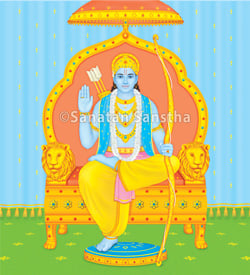
- 1. Ritualistic worship of Shriram
- 2. Some common rituals in the worship of Shriram
- 3. Draw sattvik rangolis that attract and emit ShriRam tattva (Principle)
- 4. Recitation of Shriramraksha stotra for eliminating distress caused by negative energies
- 5. Ram and Sita Gayatri
- 6. Chanting name of Shriram’s
- 7. Worship of Shriram is beneficial for going from many to one
1. Ritualistic worship of Shriram
Since Shriram is an Incarnation of Shrivishnu, His worship is akin to that of Shrivishnu.
2. Some common rituals in the worship of Shriram
Every Deity has a specific science underlying its worship. This means that in the worship of a specific Deity, performing the ritual in a specific way has an underlying science. This action helps the devotee derive maximum benefit from the Deity’s Principle. By God’s grace, Sanatan’s seeker H. H. (Mrs.) Anjali Gadgil has received subtle-knowledge on how to perform certain common rituals in the worship of Shriram. These are given in the table ahead.
| Act of worship | Divine Knowledge received about the act |
|---|---|
| 1. Before worshipping Shriram, how should the worshipper apply gandha to himself ? | Applying a vertical tilak with the ring finger (just as Shrivishnu has on Him) or applying gandha which is filled in between |
| 2. With which finger should the gandha be applied to Shriram ? | With the ring finger |
| 3. Offering flowers
Which flowers should be offered ? In what number ? How should the flowers be offered ? In what shape should the flowers be |
Jai Four or in multiples of four The stalk of the flower should be towards the Deity Elliptical shape (By filling the space in between or by letting it be empty)
|
| 4. Waving incense-sticks
Incense-sticks of which fragrance should be waved for tarak (Saviour form) worship ? Incense-sticks of which fragrance should be waved for marak (Destroyer form) worship ? In what number ? What should be the method of waving with a lit lamp ? |
Chandan, kēwaḍa, champa, chamēli, jai and ambar
Heena and darbar Two Holding it between the thumb and the index finger of the right hand, and moving it three times in a clockwise direction |
| 5. Which fragrance should be offered ? | Jai |
| 6. How many pradakshinas (Circumambulations) should be performed around Shriram ? | Minimum three or in multiples of three |
3. Draw sattvik rangolis that attract and emit Shriram tattva (Principle)
4. Recitation of Shriramraksha stotra
for eliminating distress caused by negative energies
The stotra, upon recital of which, one is protected by Shriram, is known as Shriramraksha stotra. Deity Shiva appeared in the dream of Sage Budhakoushik and recited the Shriramraksha stotra to Him. When He woke up in the morning the Sage wrote it down. It was in Sanskrut. Recitation of this stotra eliminates problems and drives away spirits / ghosts. The benefits derived by reciting this stotra (as mentioned in it) are – long life, happiness, progeny, victory and humility. Apart from this, the stotra describes Shriram, the essence of Ramayan, praises Shriram, praises devotees of Shriram, salutes and praises ancient Sages, narrates the importance of chanting the Name of Shriram etc.
‘स्तूयते अनेन इति’
Meaning : The stotra through which the Deity is glorified.
It includes not only the praise of the Deity, but also has the power to create a kavach (Protective sheath) around the one reciting the mantra. It is a prayer unto a Deity to protect the body. Using various mantras, a subtle-kavach can be created around the body of the individual. These kavach of mantras are more powerful than gross kavach. A gross kavach protects from gross weapons such as bullets from a gun, while a subtle kavach protects from gross attacks as well as from subtle negative energies such as ghosts etc. Regular recitation of the Shriramaraksha stotra eliminates all distress and drives away ghosts in the house. The stotra quotes the benefits of its recitation. Since it includes the sankalp (Resolve) of the composer, the one reciting it derives those benefits.
5. Ram and Sita Gayatri
दाशरथाय विद्महे । सीतावराय धीमहि । तन्नो रामः प्रचोदयात् ।।
Meaning : We are familiar with Shriram, the son of Dasharatha. We meditate upon Shriram, the husband of Sita. May Shriram provide inspiration to our intellect.
जनकात्मजायै विद्महे । भूमिपुत्र्यै च धीमहि । तन्नो जानकी प्रचोदयात् ।।
Meaning : We are familiar with Sita, the daughter of Janak. We meditate upon Sita, the daughter of the earth. May that Janaki provide inspiration to our intellect.
6. Chanting name of Shriram’s
Various forms of worship such as puja, arati etc. bestow benefit of Deity’s Principle. However, since all these have their limitations, the benefit is also limited. For continuous benefit from the Deity’s Principle, the worship of the Deity should also be continuous, and there is only one such form of worship – chanting. In the Kaliyug, this is an easy and excellent form of worship.
Some common chants of Shriram’s Name are given ahead,
A. ‘श्रीराम जय राम जय जय राम’ (Shriram Jai Ram Jai Jai Ram)
The words in this mantra are explained ahead,
Shriram : This is invoking Shriram.
Jai Ram : This denotes praise.
Jai Jai Ram : Like Namaha (I surrender unto you), this signifies surrender.
B. ‘Chanting of ‘Hare Ram Hare Ram… Hare Hare (हरे राम हरे राम …. हरे हरे)
The Kalisantaranopanishad being a part of the Krushnayajurveda is also known as Harinamopanishad. This Upanishad was narrated by Deity Brahma to Sage Narad at the end of the Dwaparyug. Its gist is that by merely chanting Narayan’s Name, the defects arising from the influence of Kali are destroyed. This Name is composed of sixteen words –
हरे राम हरे राम राम राम हरे हरे
हरे कृष्ण हरे कृष्ण कृष्ण कृष्ण हरे हरे ।।
These sixteen words are associated with the sixteen kalas (States) of the individual and destroy the covering of Maya (Great Illusion) around him.
7. Worship of Shriram is beneficial for going from many to one
From the perspective of making attempts for God-realisation, the first stage is worship of the Kuladevata (Family Deity). Once that is accomplished, the spiritual practice of worshipping Shriram, who is true to His word, devoted to only one wife and who strikes the target with just one arrow, is useful to many seekers for going from many to one.
Reference : Sanatan Sanstha’s Holy Text ‘Shrivishnu, Shriram and Shrikrushna‘
Thank you so much for making such a great information easily available …. 🙂 …. Shreeram Jay Ram Jay Jay Ram