Index
- Birth, Childhood and Education of Swami Vivekananda
- Meeting His Guru and accepting Sanyas
- Establishment of the Ramkrishna Mission
- Swami Vivekananda’s works
- Swami Vivekananda shines at the World Parliament of Religions
- Swami Vivekananda’s enlightening guidance on education system
Birth, Childhood and Education of Swami Vivekananda
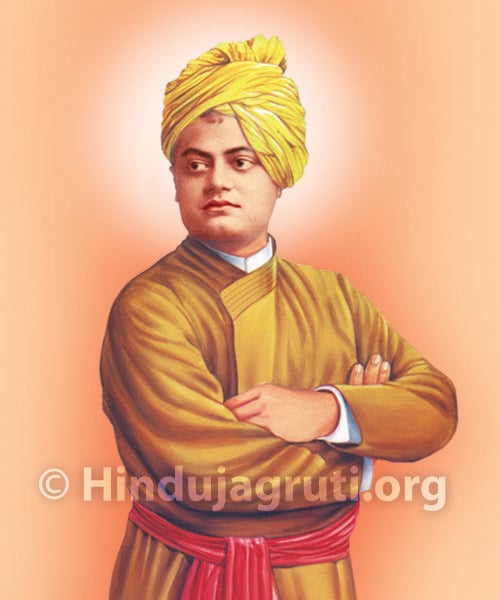
Swami Vivekananda’s original name was Narendranath Dutta. He was born on 12 January 1863 at Kolkata. His Birth Anniversary is celebrated as ‘International Youth Day’.
Right from childhood, two aspects of his behaviour stood out – One was his devout and compassionate nature, and the other was his courage. Since his whole family was spiritually inclined, he received an appropriate religious and spiritual upbringing.
Swami Vivekananda was admitted to the school founded by Ishwarchandra Vidyasagar in 1870. While in school he focused both on studies as well as body building. He had great respect for his mother tongue. I one such incident during an English language class in school, he said, “I shall not learn the language of the white master.” At least for 7 – 8 months he abstained from learning the English language. Later he learnt it owing to compulsion. Swami Vivekananda stood first in his matriculate examination, adding to the glory of his family and school. He then joined the Presidency College in Kolkata and completed his M.A. in Philosophy.
Meeting His Guru and accepting Sanyas
Dr. Ramchandra Dutta, a relative of Narendra who had been raised in his house was a disciple of Shri Ramkrishna Paramhansa. He noticed that Narendra was inspired by spiritual feelings to such an extent that he was contemplating renunciation in his childhood itself. He once told Narendra, “Brother, if your only goal in life is to further the enhancement of our Dharma, then do not get involved in the Bramho Samaj or others. You go to Dakshineshwar and meet Shri Ramkrishna Paramhansa.” Narendra met Shri Ramkrishna at his neighbor Surendranath’s house itself. Initially for some days Shri Ramkrishna did not allow Narendranath to leave his side even for a moment. He made Narendra sit next to him and gave him much advice and counsel. The two of them would have great discussions when alone.
Shri Ramkrishna had decided to give Narendra the responsibility of carrying on his mission. One day Shri Ramkrishna wrote on a piece of paper, “Narendra will perform the task of enlightening the masses.” Somewhat hesitantly Narendranath replied, “I won’t be able to do all this.” Shri Ramkrishna immediately spoke with great resolve, “What? Won’t be able? Your bones will perform this task?” Later Shri Ramkrishna initiated Narendranath on the path of Sanyas and gave him the name Swami Vivekananda.
Establishment of the Ramkrishna Mission
Swami Vivekananda along with Taraknath, another disciple of Ramkrishna, established the Ramkrishna Mission after Mahasamadhi of Shri Ramkrishna Paramhansa. It began its activities from a dilapidated building at Baranagar, near Kolkata. Earlier it was believed that this place was a haunted house. Vivekananda kept Shri Ramkrishna’s mortal ashes and some other objects used by him, at this place. Soon Shri Ramkrishna’s disciples started living there.
Swami Vivekananda’s works
Putting a curb on religious conversions with his stormy propagation of ‘Vedanta’
India was ruled by the British during that period. The British education system and strategies of Christian missionaries to mislead people and belittle Hindu literature, led to the affluent class in Bharat developing an inferiority complex towards Hindu Dharma and culture. They were made to believe that Hindu Dharma is of a very low standard, inhuman and barbarian. However, due to the fiery propagation of ‘Vedanta’ worldwide by Swami Vivekananda, many Hindus who would have otherwise been baptized and converted to Christianity by the missionaries, started developing pride in Hindu Dharma and its philosophy.
Giving the message of spiritual unison and creating new consciousness amongst youth
Swami Vivekananda represented India and consequently, Hindu Dharma at the World Parliament of Religions held in Chicago, USA, in the year 1893. Swami Vivekananda gave a message of spiritual unity to the world in this conference. He also emphasised that along with spiritual progress, worldly progress was equally important. Swami Vivekananda’s guidance helped to generate new consciousness and enthusiasm amongst the youth.
Awakening patriotism
Continuous foreign invasions, immorality, looting, oppression of women and violence had crushed Hindus mentally. Swami Vivekananda undertook the mission of propagating the message of Shri Ramakrishna Paramhansa and pulling out Hindus from this defeated mentality. He travelled all over India for this great mission and imbibed patriotism and national pride amongst people through his spiritual discourses. Moreover, he made the whole world realize the importance of Hindu Dharma and Hindustan.
– Gurudev Kate swamiji (Saptahik Sanatan Chintan, 28th September 2006, Issue No. 37)
Swami Vivekananda shines at the World Parliament of Religions
The premonition regarding the visit to Chicago
One night Swami Vivekananda saw a miraculous dream. Shri Ramkrishna’s blazing form was moving ahead over the seas and beckoning Swami Vivekananda to follow him.
Swami Vivekananda opened his eyes. His heart was filled with indescribable ecstasy. At the same time he heard very clearly a divine voice saying, “Go”. Then he resolved to go abroad and completed all arrangements within a day or two.
Departure for the World Parliament of Religions
Swami Vivekananda left Indian shores, aboard the ship, ‘Peninsular’ on 31 May 1893. He reached Vancouver port in Canada on 15 July. From there he travelled by train to the city of Chicago in America. He came to know that a World Parliament of Religions was going to be held on 11 September.
Swami Vivekanananda did not have the invite required to participate in this conference. Further, even the date to register as a Representative had lapsed. Yet, wherever he went people were attracted to him. On the very first day he met Prof. J.H. Wright, who was teaching Greek at Harvard University. The two of them conversed for almost four hours. The professor was so impressed by Swami Vivekananda’s talent and intellect that he accepted the responsibility of giving Swamiji admittance to the World Parliament of Religions as a representative.
Swami Vivekananda participates at the Chicago interfaith conference
Swami Vivekananda proved to be a true representative of Hinduism as he made his fervent appeal for universal tolerance from the dais of the World Parliament of Religions at Chicago. It was a divine plan to allow this Saint to introduce the world to the great Hindu Dharma. This conference was inaugurated with the Chanting of hymns by the various religious heads. It was a melodious beginning to the conference. On the dais, at the centre, was the religious head of the Roman Catholic Sect of America.
Swami Vivekananda was not the representative of any particular sect. He had arrived at the conference as the representative of the Sanantan Hindu Vaidik Dharma of all Bharatvarsha. The conference was attended by almost 6 to 7 thousand people. As per the instructions of the chairperson, each representative on the dais was reading out his pre-prepared speech.
Swami Vivekananda had not prepared any written speech. Finally he stood up from his seat, made a silent prayer to his Guru, and started his address, “Sisters and brothers of America”. These words had such miraculous strength in them that those thousands gathered stood up and there was continous applause. The emotional appeal in those compassionate words had stirred every heart. It was the first time ever that any orator had referred to the whole of mankind as ‘Sisters and Brothers’. Further he entranced all those present with his brilliant and powerful oration.
Swami Vivekananda felt that the Hindu Samaj has the potential to become the spiritual guru of the world. After centuries, someone had again shown to the Hindu society its own wide horizons. Yet Swami ji did not criticise any religion. He did not degrade any religion. He only wiped the dirt that had accumulated on Hindu Dharma owing to its ill-treatment and affronts at the hands of its invaders.
Swami Vivekananda showed Hindu Dharma its own radiant self and placed it on the highest pedestal of the World Parliament of Religions. When speaking about Bharat, he said that it is a sacred land, a land with a divine purpose. Bharat is the abode of spirituality and introspection. Right from the ancient ages, founders of religious tenets were born here. They satiated the scorched earth with the cooling waters of the Eternal truth – Sanatan Satya. It’s the only land where one can experience not only tolerance but also affection for other religions.
Swami Vivekananda’s sermons
Swami Vivekananda returned back to Kolkata to a grand welcome after projecting Bharat in its deserved glory. ‘The Plan of my movement’, ’Vedant in everyday life of Bharat’, ‘Our duty for the day’, ‘The great sons of Bharat’, ‘ Future of Bharat’ were some of the subjects on which he started delivering lectures. His language at all times remained resplendent throughout all his speeches. His incisive thoughts had a great impact on both Indian as well as foreign minds. He spread the message of Vedanta all around the world.
Real Sanyas is to sacrifice the self for the betterment of others
Swami Vivekananda held a lot of respect for the spiritual heritage of Bharat, but he attacked through his speeches its undesirable man-made customs. Thus his speeches served as a wake-up call even to the Hindu society. His ardent appeal struck lightning in the hearts of his dormant countrymen. His natural state of being would have been to meditate on the formless eternal entity i.e. Nirvikar Samadhi. Yet he set aside his own renunciation and thought about the mortal struggles, sorrows and joys of common people; throughout his life he strived for their upliftment. ‘Real Sanyas is to sacrifice the self for the betterment of others’ – he lived this axiom.
Swami Vivekananda’s enlightening guidance on education system
We must have life-building, man-making, character-making education.
The burden of knowledge not understood throughout life but somehow filled in the brains does not mean education. Education is not the amount of information that is put into your brain and runs riot there, undigested all your life. We must have life-building, man-making, character-making education. If you learn 4-5 good thoughts and try to inculcate them in yourself, your education would be better than learning by heart a whole library!
Today’s education has completely failed in creating ‘human’ but has created terrible defects
Do you understand that the responsibility of spiritual and worldly education should be shouldered by us? Today, the education imparted to you has a few good things, but there are so many terrible defects that the good things are becoming ineffective. The first thing is that the education is not creating man but it is completely negative education. Such negative education or education that teaches only to condemn (our culture) is worse than death.