Skip to content
Skip to content
Contents
Chapter 1: The science underlying the rituals performed in the Family
- Birthday
- 1. Spiritual meaning
- 2. History and importance of a birthday celebration
- 2.1 Birthday of an embodied soul in the ‘Satyayug’
- 2.2 Birthday of an individual in the Treta and Dvaparyugs
- 3. Importance of celebrating the birthday as per the Hindu lunar calendar
- 4. Method of birthday celebration
- 5. Science behind the ritual of birthday celebration
- 5.1 Three rites in birthday celebration and the science behind them
- 5.2 Wearing new clothes after the bath with oil massage is like wearing an armour of chaitanya
- 6. Spiritual experiences during the celebration of a birthday
- 7. Acts forbidden on a birthday and the science behind it
- 8. Subtle analysis of a birthday celebrated in western style
- 9. A saint’s birthday
- 10. The birthday celebration of children, contemporaries, the aged and saints
- Ritual of waving a lit lamp (Aukshan)
- 1. Articles required for the ritual of waving lit lamp and their arrangement
- 2. Method of waving a lit lamp
- 3. The science behind the actions during ‘Aukshan’
- 3.1 Why is it that akshatas should be placed on the vermillion applied on the forehead of the individual?
- 3.2 Why is it that while doing Aukshan waving is done by the ring and beetlenut taken in hand?
- 3.3 Why is the ring after waving around the face, touched to the platter (used for the ritual)?
- 3.4 What is the science underlying using an ornament instead of a coin in the ritual of waving lit lamp?
- 3.5 Various methods of the ritual of waving lit lamp
- 3.6 Why are the unbroken rice grains (Akshatas) kept below the lit lamp platter when it is put down after the ritual is over?
- 3.7 Why is the lit lamp platter moved only once while performing the ritual for Saints?
- 4. Reason behind the various methods of the ritual of moving lit lamp and the effect on the embodied soul
- 5. A spiritual experience of the ritual of waving lit lamp
- Ritual of gifting
- 1. Meaning of a gift
- 2. What should be gifted and what should be the bhav (spiritual emotion) while gifting?
- 3. Why are turmeric and vermillion applied to a gift?
- 4. What is the best gift and who can offer it?
- The Pacification ritual for the elderly
- 1. The purpose and the day for the ritual for shanti
- 2. Types of shanti as per the age (of the person), the main Deities of the ritual and substances used in offerings
- 3. The importance of ‘Sahastrachandra darshan’
- 4. Subtle observations of some steps in the ritual for shanti
- 4.1 Vaishnaviii Shaantii
- 4.2 Ugrarath (shashthi) Shaantii
- 4.3 Sahastrachandra darshan
- 4.4 Raudriii Shaantii
- Puja of Sri Satyanarayan
- 1. Importance of performing Sri Satyanarayan puja prior to a function
Chapter 2: Science behind the social rituals
- Inauguration (Udghaatan)
- 1. Definition and importance
- 2. Rituals in inaugurating
- 3. Why the western tradition of inaugurating by cutting a ribbon is inappropriate?
- Lighting a Lamp
- 1. The implied meaning and importance of lighting a lamp
- 1.1 Activation of the energy of resolve of God
- 1.2 Creation of a protective sheath around the venue
- 2. Science behind lighting a lamp and breaking a coconut when inaugurating a programme on stage
- 3. Science behind lighting a lamp on the stage
- 3.1 Should unbroken rice grains (akshatas) be kept under the lamp before lighting it ?
- 3.2 Why is it more appropriate to use oil instead of ghee (clarified butter) in the lamp ?
- 3.3 Why is a lamp lit with another small lamp (kaypanji) and not with a candle ?
- 4. Why is it more appropriate for a saint or a sattvik person to light a lamp on the stage?
- Felicitation
- 1. Spiritual meaning and importance
- 2. Who should be felicitated?
- 3. Who should do the felicitation?
- 4. Honouring a worthy person
- 5. Honouring a saint
- 6. What should be avoided during felicitation?
- 7. Comparison of felicitation of a deserving individual, a saint and idol of a deity
- Release of a holy text or book using spiritual principles (granthaprakaashan)
- 1. Meaning of the word ‘Prakaashan’
- 2. Shloks (Holy verses)to be recited during the function of book / holy text release
- 3. Steps in the function of a holy text/book release
- 4. Why should one not release a book by tying it with a ribbon and then untying it ?
- 5. Subtle analysis done by Mrs. Anjali Gadgil at the release of the holy text ‘Sadhana’, of the Sanatan Sanstha
- Why is it necessary to chant Sanskrut shloks during programmes related to various topics and which one?
- Organisation of a stage programme of one or two sessions
- Condolence meeting


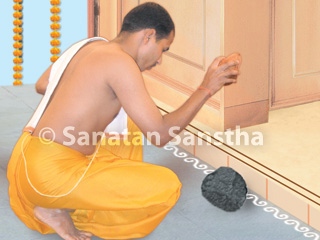
 Why inauguration ceremony should be done by breaking a coconut ?
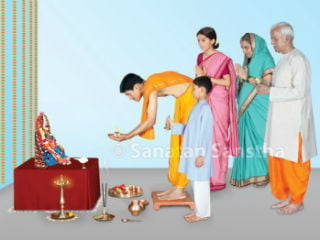 Performing Aarti
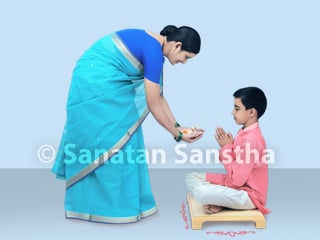 Spiritual birthday
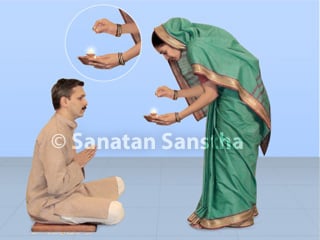 Ritual of waving a lit lamp (Aukshan)
 Namaste