HJS Top Campaigns
Share |

speaker Jap and Aarti

Sree Krushna Jayanti

Sudarshan

Content -

1. Introduction
2. Video
3. Sattvik Image
4. Significance and Celebration
5. Series of Articles on Lord Krushna
6. Defamation of Lord Krushna by MF Husain and others

Introduction

Synonyms: Krushnajayanti, Krushna Jayanthi, Janmashtami, Janmashtam, Gokulashtami, Shri Krushna Jayanthi, Krushnashtami, Kalashtami, Gopalkala.

The birth of Lord Krushna is celebrated at midnight on Sri Krushna Jayanti. This year it falls on 3rd September 2007.

According to the Hindu lunar calendar, Lord Krushna was born on the eighth day (ashtami) of the second (dark) fortnight of the month of Shravana. Five thousand years ago, He incarnated, at the end of the third cosmic era, 'Dwapar Yuga' and the beginning of the present era, 'Kali Yuga'. The divine principle (tattva) of Lord Krushna is most active on this day of the year.

At midnight, the ritual of waving lit lamps (aarti) is performed. Krushna Jayanti is especially significant from the viewpoint of establishing Righteousness (Dharma), and surrendering unto The Lord.

Video (Marathi)

This video gives practical and scientific information about Sree Krushna Janmasthami. Video includes how to prepare prasadam i.e. Dahi-kala, spitiual significance of Krushna Janmashtami. Currently video is available only in Marathi language.

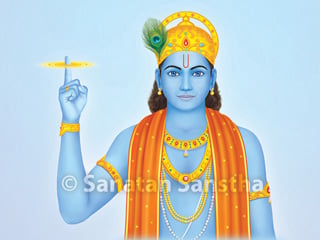
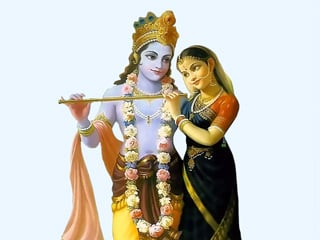
Sattvik Image of Lord Krushna

This image is made by seekers of Sanatan Sanstha.


speaker Jap and Aarti
[^Top]

Significance and Celebration

Following points provide information about Janmashtami. For details about Lord Krushna, please refer the series of articles.

According to Numerology

The number eight is a reducing number (kshayaank). According to numerology the number eight is responsible for generating revolutionary thoughts. It would not be wrong to say that Sri Krushna's entire life was an era of revolution.

Celebration

1. The birth of Lord Krushna is celebrated at midnight on Krushna Jayanti. At midnight, the ritual of waving lit lamps (aarti) is performed. (Click here for the listening aarti.)

2. His statue is placed in a swing and devotionally offered many sumptuous food dishes, in particular kheer (a sweet dish made from milk, sugar and rice/vermicelli) or halva/sheera (a sweet dish made from semolina, ghee and sugar).

3. People incorrectly think that Lord Krushna loved butter and so offer butter to Him. In fact, He ate butter because the evil king Kansa taxed the people, and in order to pay their taxes, they were forced to sell butter. To prevent these civilians from suffering and caving into the unrighteous demands of the king, Lord Krushna would eat or spill their butter. In doing so, He taught the people to develop a fighting spirit (kshatravrutti) and not to tolerate injustice in any capacity.

4. One should fast the whole day before the celebration at midnight. The fast is ended either at midnight by eating the Holy sacrament (prasad) or the next morning by eating an offering of a mixture (dahikala) of curd (yogurt with enzymes retained) with various eatables, milk and butter. When grazing the cattle along with the cowherds at Vraj (a city in ancient India - in modern day North India), Shri Krushna mixed the lunches of His companions with that of His own and ate it along with them. In keeping with this story, later it became customary to prepare dahikala and break a hanging pot containing curd on the day after Gokulashtami.

5. Temples are decorated for the occasion. Kirtans are sung, bells are rung, the conch is blown, and Sanskrit hymns are recited in praise of Lord Krushna. At Mathura (a city in North India, near the birthplace of Lord Krushna), special spiritual gatherings are organized at this time. Pilgrims from all over India attend these festive gatherings.

Fasting on this day as well as observing Rushipanchami, a vowed religious observance (vrat), reduces the effects of menses, impurity and touch on women. [The effects on men are reduced by performing acts of repentance (prayashchitta karma), such as shaving the head, etc. Performing the ritual of Udakshanti reduces the effects on the premise.]

Significance behind the celebration

Krushna Jayanti is especially significant from the viewpoint of establishing Righteousness (Dharma), and surrendering unto The Lord.

Establishing Righteousness

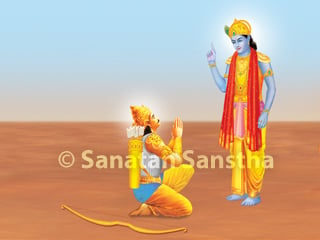
Lord Krishna and Arjun

"Where there is Krushna, there is Dharma, where there is Dharma, there is victory. Since Duryodhana, leader of the Kauravas, did not observe dharma, he did not have Krushna. No Krushna, no victory."- Sage Ved Vyas

His teachings in essence

During the Mahabharat war Lord Krushna uttered 700 shlokas (holy verses) in the form of the 'Bhagavat Gita' to convince the reluctant Arjuna to fight his own kith and kin to reinstate Righteousness (Dharma). The Lord finally uttered the essence of His teachings in the following verse (18/66) : "O Arjun! Forsake all your personal beliefs and surrender to me. Do not lament, for I shall deliver you from all sins."

Devotion Increasing

Not only is His principle (tattva) most active on Krushna Jayanti, but in present times His energy is 100% manifest, and He rushes to the aid of the devotee who surrenders unto Him. His devotee long to feel closer to Lord Krushna every day and not just on Sri Krushna Jayanti. To invoke Lord Krushna's principle the best solution is to repeat Lord Krushna's Name as follows: “Om Namo Bhagavate Vasudevaya” continuously through every action.

Deriving maximum benefit

Chanting (repetition) of His Name invokes His presence within oneself as The Lord and His Name are one. All of the qualities that reside in The Lord are there in The Name. Thus, repeating His Name will surely herald His presence and blessings in life.

Therefore, to derive maximum benefit from Krushna Jayanti, devotees can daily make conscious efforts through chanting and prayer to surrender at the Lord's lotus-feet. Such spiritual practice would equip one to participate in establishing Righteousness by spreading the importance of Spirituality to others, removing misconceptions about it and helping curb incorrect practices.

Series of Articles on Lord Krushna